Nutrition Facts
- Amount Per Serving
- Calories 190kcal
- % Daily Value *
- Sodium 3mg1%
- Total Carbohydrate 12g4%
- Sugars 10g
* Percent Daily Values are based on a 2,000 calorie diet. Your daily value may be higher or lower depending on your calorie needs.
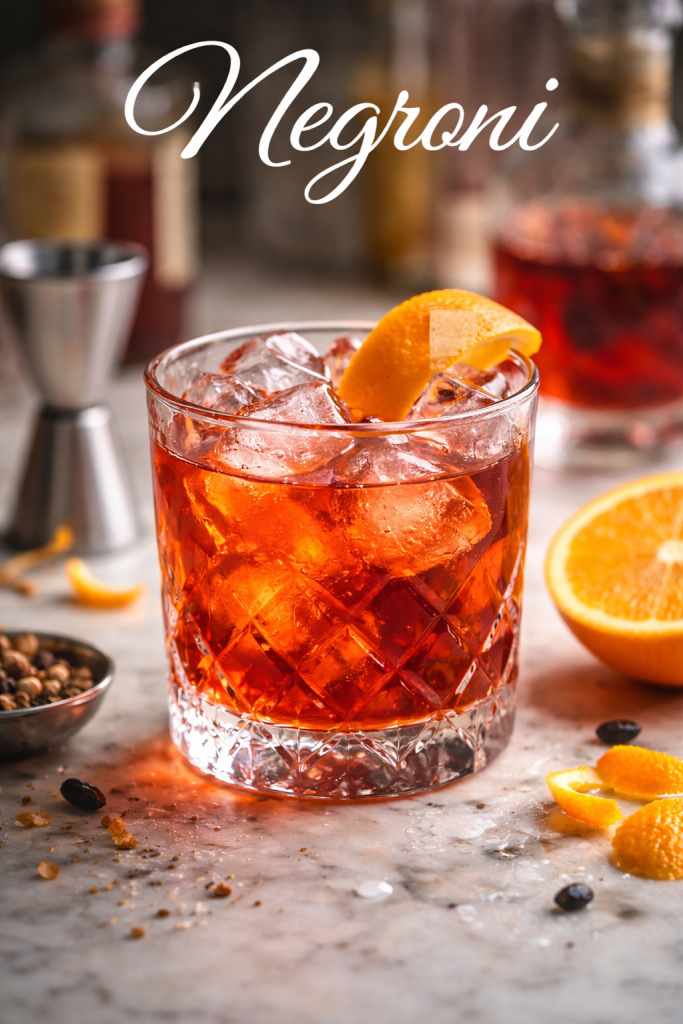
Have you ever tasted a cocktail that seems impossibly simple yet impossibly complex at the same time? That's the Negroni. Three ingredients, equal measures, and a century of history combine to create what many bartenders consider the perfect drink .
This classic negroni recipe delivers that iconic balance of bitter, sweet, and botanical flavors that has captivated cocktail lovers for generations. Made with just gin, Campari, and sweet vermouth, it's a drink that's greater than the sum of its parts—crisp, refreshing, and deceptively sophisticated .
What makes this version special? I'm sharing the precise technique that professional bartenders use, along with insights from flavor science that explain why this simple combination works so beautifully. You'll learn why the 1:1:1 ratio is sacred, how proper dilution transforms the drink, and why a fresh orange twist isn't just garnish—it's chemistry. Let's raise a glass to Italy's greatest cocktail export.
The story of the Negroni begins not with its namesake, but with its key ingredient. In the 1860s, Gaspare Campari opened a café in Milan to sell his newly created bitter liqueur. One of the drinks they served was a simple fusion of Campari and Cinzano sweet vermouth, dubbed the Milano-Torino—a nod to the two cities that produced the ingredients .
When American tourists flocked to Europe during Prohibition, they fell in love with this drink. The locals, in tribute, renamed it the Americano .
According to the most popular origin story, the Negroni as we know it was born in Florence around 1919. Count Camillo Negroni, a regular at Caffè Casoni (later called Caffè Giacosa), frequently ordered Americanos. One day, he asked the bartender, Fosco Scarselli, to strengthen his favorite drink by replacing the soda water with gin. Scarselli obliged, and the Count loved the result .
The new concoction became increasingly requested, and soon the Negroni family founded a distillery in Treviso producing a ready-to-drink version called Antico Negroni 1919 .
A competing origin story involves General Pascal Olivier de Negroni, a French Army captain who supposedly invented the drink in Senegal in the late 1800s. According to the General's descendants, he shared the recipe throughout Dakar, and some accounts suggest it was created to celebrate his marriage .
Regardless of which origin you believe, one thing is certain: the word "Negroni" doesn't appear in English cocktail guides until 1947, adding an air of mystery to its true beginnings .
Today, the Negroni is beloved worldwide, with an entire week dedicated to its celebration where participating venues donate proceeds to charity . It remains a favorite of bartenders themselves—a rare honor in an industry where professionals typically reach for beer on their days off .
Flavor chemist Neil C. Da Costa has noted that cocktails like the Negroni achieve their complexity through the interaction of hundreds of flavor compounds . Despite having just three ingredients, the Negroni covers almost the entire range of human taste sensations—bitter, sweet, and umami—while the gin adds botanical aromatics .
Campari provides the bitter foundation with its proprietary blend of herbs, fruits, and spices. Sweet vermouth contributes sweetness, herbal complexity, and viscosity. Gin bridges them with juniper and botanical notes, creating a flavor profile that's simultaneously aggressive and harmonious.
The 1:1:1 ratio isn't arbitrary—it's the result of decades of refinement. As one bartender perfectly expressed it: "Three ingredients, equal parts in whatever vessel you want. I don't even think of this as a cocktail anymore, it's just a Negroni" .
Some drinkers prefer to adjust the ratio, increasing the gin to 2:1:1 or 3:2:2 for a more spirit-forward version . But purists argue that deviating from equal parts creates a different drink entirely. "You may prefer a 3:2:2 ratio...but that is not a Negroni," notes one commenter. "A Negroni is 1:1:1" .
Stirring the Negroni with ice serves two crucial purposes: chilling and dilution. The average alcohol content hovers around 24% ABV, and proper dilution (about 20-25%) softens the alcohol's bite while allowing the botanical and herbal notes to emerge .
Professional bartenders have even experimented with carbonated Negronis, discovering that extremely cold liquors hold CO2 more effectively. "If you figure out how much water is being added into the cocktail when you stir it or shake it and add that much before you carbonate, it holds almost twice as much CO2," explains one bar manager .
That orange twist isn't just for looks. When you express the oils over the drink, you're adding limonene and other aromatic compounds that interact with the bitter Campari and botanical gin. The citrus oils float on the surface, greeting your nose with every sip and preparing your palate for the complexity to come .
The Negroni was designed as an aperitivo—a pre-dmeal drink meant to stimulate the appetite . Here are perfect companions.
This classic negroni recipe delivers the perfect balance of bitter Campari, botanical gin, and sweet vermouth that has made it one of the world's most beloved cocktails . With just three ingredients and a simple stir, you can create a drink that's crisp, complex, and endlessly satisfying—whether served on the rocks or straight up.
Prepare your glass. Fill an old-fashioned glass with large ice cubes. The larger surface area melts more slowly, providing controlled dilution .
Combine and stir. Pour the gin, Campari, and sweet vermouth directly over the ice. Stir gently for 15-20 seconds to combine and chill. The drink should be perfectly integrated and ice-cold .
Garnish. Using a vegetable peeler, cut a thick strip of orange peel (avoid the bitter white pith). Hold it over the glass, colored side down, and give it a firm twist to express the essential oils onto the surface of the drink. Rub the peel around the rim of the glass, then drop it in .
Serve immediately. Enjoy as an aperitivo before dinner.
Chill your glass. Place a coupe or cocktail glass in the freezer to chill, or fill it with ice water while you prepare the drink.
Stir with ice. Fill a mixing glass with ice. Add the gin, Campari, and sweet vermouth. Stir well for 20-30 seconds until properly chilled and diluted .
Strain. Empty your chilled glass (if using ice water) and strain the cocktail into it.
Garnish. Express an orange twist over the drink and drop it in .
* Percent Daily Values are based on a 2,000 calorie diet. Your daily value may be higher or lower depending on your calorie needs.
The Negroni occupies a unique position in the cocktail world. It's simultaneously a beginner's drink and a connoisseur's obsession. Bartenders who rarely drink cocktails make an exception for the Negroni .
The Negroni's simple formula has spawned countless variations. Using the concept of "cocktail edit distance," we can see how one ingredient swap creates an entirely new drink :
There's something meditative about making a Negroni. The simple act of measuring three equal parts, the gentle stir, the expression of orange oil—it connects you to generations of drinkers before you. As Oliver Stuart, former Bartender of the Year, puts it: "When made correctly it is a perfect balance of alcoholic strength, bitterness, sweetness, and citrus flavours. All the while remaining floral and refreshing yet strong and smooth. You can't stop after the first Negroni, as it leaves you craving the next" .
I first encountered the Negroni on a sweltering summer evening in Rome, sitting at a tiny outdoor café as the sun painted the ancient buildings gold. An elderly gentleman at the next table nursed a deep red drink that looked like liquid ruby. When I asked what he was drinking, he simply said, "La vita" — life.
I ordered the same, and that first sip was a revelation. Bitter, yes, but also sweet, herbal, complex—a drink that demanded attention and rewarded it generously. I've been hooked ever since.
Now, whenever I make a Negroni, I'm transported back to that Roman evening. The ritual, the flavor, the moment of pause—it's more than a cocktail. It's a reminder to slow down, to savor, to appreciate the simple things done well.