INTRO
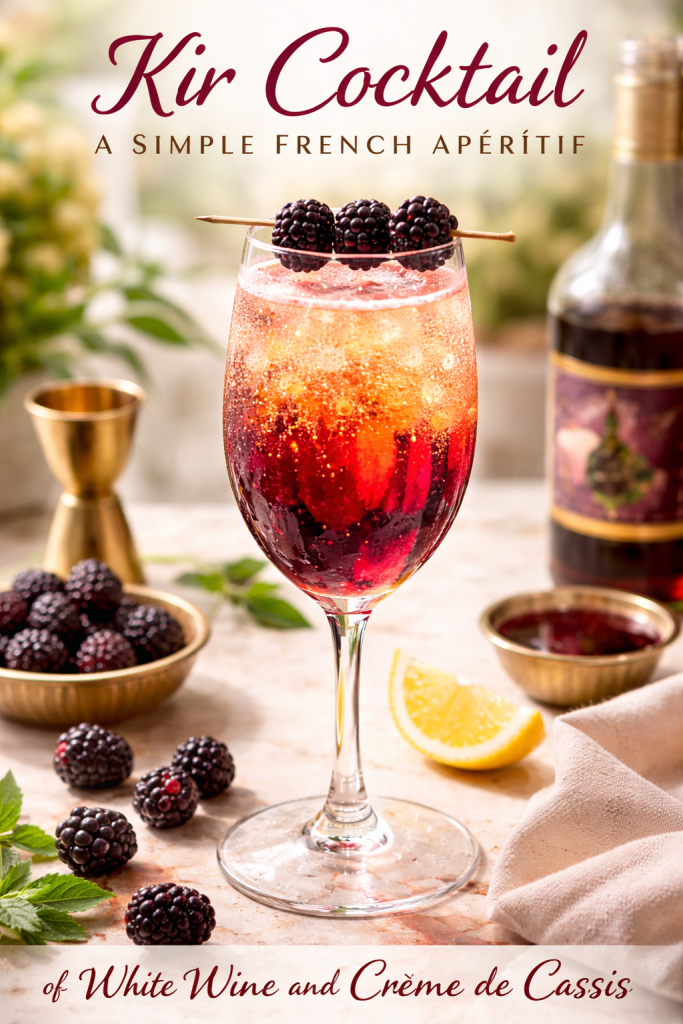
Have you ever taken a sip of a drink and felt instantly transported to a sidewalk café in a charming French town? That’s the magic of the Kir cocktail. This isn't just a drink; it's a cultural institution. With just two ingredients—chilled dry white wine and a splash of blackcurrant liqueur called crème de cassis—the Kir is the epitome of elegance and simplicity. It’s the classic French apéritif, designed to wake up the palate and spark conversation before a meal.
In this post, we're not just throwing ingredients together. We’re diving deep into what makes a Kir truly special. From its fascinating post-war origins in Burgundy to the subtle chemistry that makes the combination of sharp wine and sweet berries so irresistible, you'll learn everything you need to know. I'll share my expert tips on ratios, ingredient selection, and technique so you can mix a perfect, balanced Kir that rivals any you'd find in Dijon.
THE HISTORY
The story of the Kir is a tale of heroism, local pride, and deliciously practical marketing. The drink originated in the Burgundy region of France, but it wasn't always called a Kir. It was originally known as a blanc-cassis, a simple mixture of local white wine and blackcurrant liqueur . While crème de cassis had been produced commercially since 1841, the drink was a regional staple, popular in local cafés .
Its identity—and name—changed forever thanks to Canon Félix Kir. A Catholic priest, he was a hero of the French Resistance during the Second World War and later became the long-serving mayor of Dijon from 1945 to 1968 . After the war, Mayor Kir was a pioneer of the "twinning" movement, hosting many international delegations. He wanted to showcase the best of his beloved Burgundy and would serve his guests the local blanc-cassis at receptions . This simple act was a masterstroke of public relations, promoting two of the region's key products: the sharp, crisp Aligoté white wine and the sweet, dark crème de cassis . The drink became so associated with the charismatic mayor that it was eventually renamed in his honor. He even allowed one producer to use his name, later extending the right to all, cementing the "Kir" as a global classic .
THE SCIENCE
Why do these two simple ingredients work so harmoniously? It's a perfect case of culinary chemistry balancing act. The foundation of a great Kir is a dry white wine, traditionally the Bourgogne Aligoté. This wine is known for its high acidity and lean, unoaked profile . On its own, it can be a bit too austere and sharp for some palates.
Enter the crème de cassis. This isn't a simple syrup; it's a liqueur made by macerating blackcurrants in neutral alcohol, then adding sugar . The result is intensely fruity, deeply colored, and very sweet, with a high residual sugar content (around 400g/L). When you combine the two, the sugar and fruit concentration in the cassis counterbalance the sharp acidity of the wine. The sweetness "takes the edge off," softening the wine's aggressive notes and allowing its more subtle fruit flavors to emerge . The result is a perfectly balanced sip: the acidity provides a refreshing, crisp structure, while the sweetness adds body and a luscious berry flavor. The goal is a synergy where the whole becomes far greater than the sum of its parts.
GOOD PAIRING FOOD AND DRINK
The Kir is a classic apéritif, meaning its job is to stimulate the appetite. Therefore, it pairs best with lighter fare that won't overwhelm its delicate balance.
- One Appetizer: Smoked Salmon Canapés . The rich, oily, and salty flavor of smoked salmon on a piece of toasted baguette with a touch of crème fraîche is a classic pairing. The saltiness and richness are a perfect counterpoint to the crisp, fruity-sweet cocktail.
- One Main Course: Quiche Lorraine . This savory custard tart with bacon and cheese is a French lunch staple. Its eggy, savory, and slightly salty profile mirrors the food-friendly nature of the wine in the Kir, making for a harmonious and satisfying meal.
- One Side Dish: While not a traditional side, a simple Salade Verte with a light vinaigrette works beautifully. The acidity in the salad dressing echoes the wine's acidity, while the fresh, crisp lettuce provides a palate-cleansing contrast to the drink's slight sweetness.
- One Dessert: Fresh Berry Tart . A tart filled with pastry cream and topped with fresh raspberries, blackberries, or strawberries echoes the dark fruit notes of the crème de cassis. It's a logical and delightful progression from the cocktail itself.
- One Cocktail and One Non-Alcoholic Drink:
- Cocktail: Kir Royale. This is the most famous variation, where the still white wine is replaced with Champagne or another high-quality dry sparkling wine . It transforms the drink into a celebratory, luxurious treat with a festive fizz.
- Non-Alcoholic: Sparkling Blackcurrant Spritzer. For a sophisticated alcohol-free version, combine a high-quality blackcurrant syrup (like those used in French cafes) with a dry non-alcoholic sparkling wine or a well-chilled sparkling lemonade . The combination of sweet berry and dry bubbles perfectly mimics the origina
.