Nutrition Facts
- Amount Per Serving
- Calories 175kcal
- % Daily Value *
- Total Carbohydrate 8g3%
- Sugars 8g
- Protein 0.2g1%
* Percent Daily Values are based on a 2,000 calorie diet. Your daily value may be higher or lower depending on your calorie needs.
Intro
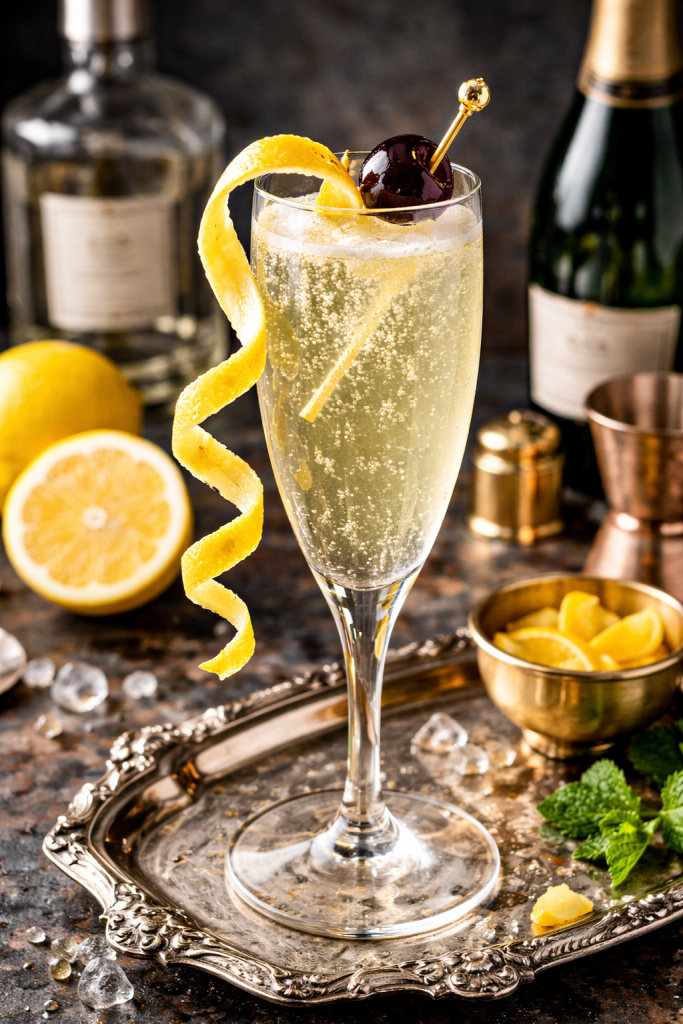
Few cocktails pack as elegant a punch as the French 75. With its bright, citrusy kick followed by a cascade of delicate bubbles, this champagne cocktail has been a symbol of sophistication for over a century. Named after a powerful World War I artillery piece, the French 75 combines gin, fresh lemon juice, simple syrup, and Champagne into a drink that's at once refreshing and formidable. It's the kind of cocktail that makes any occasion feel like a celebration—whether you're toasting a special milestone or simply elevating a quiet evening at home. This recipe walks you through the classic preparation, complete with pro tips to ensure every sip is perfectly balanced.
The History
The French 75's story begins not in a cocktail lounge, but on the battlefields of World War I. The drink takes its name from the Canon de 75 modèle 1897, a French 75-millimeter field gun that was renowned for its rapid-fire capability and precision—firing up to 28 shells per minute and playing a decisive role in stopping the German advance on Paris . It was a symbol of military power and became a key propaganda tool during the war, soon known simply as "le soixante-quinze" .
The cocktail itself first appeared around 1915, likely created by a French bartender—most believe it was Henry Tépé of Henry's Bar in Paris . The drink was said to have such a kick that it felt like being shelled by the powerful French artillery piece . An early version appeared in the American press in 1915, brought to Broadway by war correspondent E. Alexander Powell . The recipe evolved through the 1920s, with Harry MacElhone of Harry's New York Bar (another legendary Paris establishment) featuring a version in his 1922 book, though that early recipe differed significantly from today's classic . The French 75 as we know it—gin, lemon, sugar, and Champagne—first appeared in a 1927 American booklet called Here's How, and was immortalized in Harry Craddock's 1930 The Savoy Cocktail Book with the now-famous warning: "Hits with remarkable precision" . From there, it became a staple of sophisticated drinking, appearing in the movie Casablanca and referenced in multiple John Wayne films .
The Science
What makes the French 75 so uniquely satisfying? It's a masterclass in balancing flavor, acidity, and carbonation. The cocktail follows the same structure as a Tom Collins, with Champagne replacing soda water—essentially, it's a Tom Collins in a tuxedo . The gin provides the botanical backbone, the lemon juice delivers bright acidity, and the simple syrup adds just enough sweetness to balance the citrus.
The Champagne, however, is where the science gets interesting. Carbonation is far more than just bubbles—it's an active ingredient in the drink's sensory experience. When carbon dioxide dissolves in water, it creates carbonic acid, which gives the drink a slight additional acidity that you can feel as much as taste . This carbonation actually triggers the same TRPA1 pain receptors that respond to spicy foods, creating that pleasant "pain and pleasure" reaction that makes sparkling drinks so compelling . The bubbles also amplify your perception of aroma, carrying the botanical notes of the gin and the citrus oils directly to your nose with each sip . This is why the order of assembly matters: you always add the Champagne last. Pouring the carbonated ingredient into the glass at the very end preserves the effervescence and keeps the mouthfeel light and airy . If you were to shake the Champagne with the other ingredients, you'd release all those precious bubbles and end up with a tragically flat drink .
Appetizer: Oysters on the Half Shell with Mignonette
Main Course: Note: This is a cocktail. For a complete meal, serve before: Pan-Seared Scallops with Lemon Beurre Blanc
Side Dish: Lemon and Herb Risotto
Dessert: Lemon Madeleines with Raspberry Coulis
Cocktail: French 125 (Cognac Version)
Non-Alcoholic Drink: Sparkling Lemon & Rosemary Spritzer (Fresh lemon juice, rosemary simple syrup, sparkling water)
The French 75 is the ultimate celebration cocktail: crisp gin, fresh lemon, and a touch of sweetness topped with elegant Champagne bubbles. It's sophisticated, refreshing, and surprisingly simple to make at home.
* Percent Daily Values are based on a 2,000 calorie diet. Your daily value may be higher or lower depending on your calorie needs.
The French 75 in Popular Culture
The French 75's elegance and evocative name have made it a favorite in films and literature for decades. It appears in the classic film Casablanca (1942), adding to the sophisticated ambiance of Rick's Café Américain . It's referenced in two John Wayne films—A Man Betrayed (1941) and Jet Pilot (1957)—and more recently appeared in the ITV series Mr. Selfridge, which is set in 1910s and 1920s London . Humorist Jean Shepherd even told a fanciful alternative origin story on the radio in 1969, crediting World War I flying ace Gervais Raoul Lufbery with its invention . The cocktail's cultural cachet endures because it represents a particular kind of timeless sophistication—a drink that feels both historic and eternally modern.
Variations Around the World
While the gin-based version is now standard, the French 75 has inspired countless variations:
Maison Ferrand (A History of the French 75)
Food & Wine (French 75)
Tasting Table (How Carbonation Plays An Important Role When Pouring Cocktails)