Nutrition Facts
- Amount Per Serving
- Calories 79kcal
- % Daily Value *
- Sodium 2mg1%
- Total Carbohydrate 10g4%
- Sugars 8g
* Percent Daily Values are based on a 2,000 calorie diet. Your daily value may be higher or lower depending on your calorie needs.
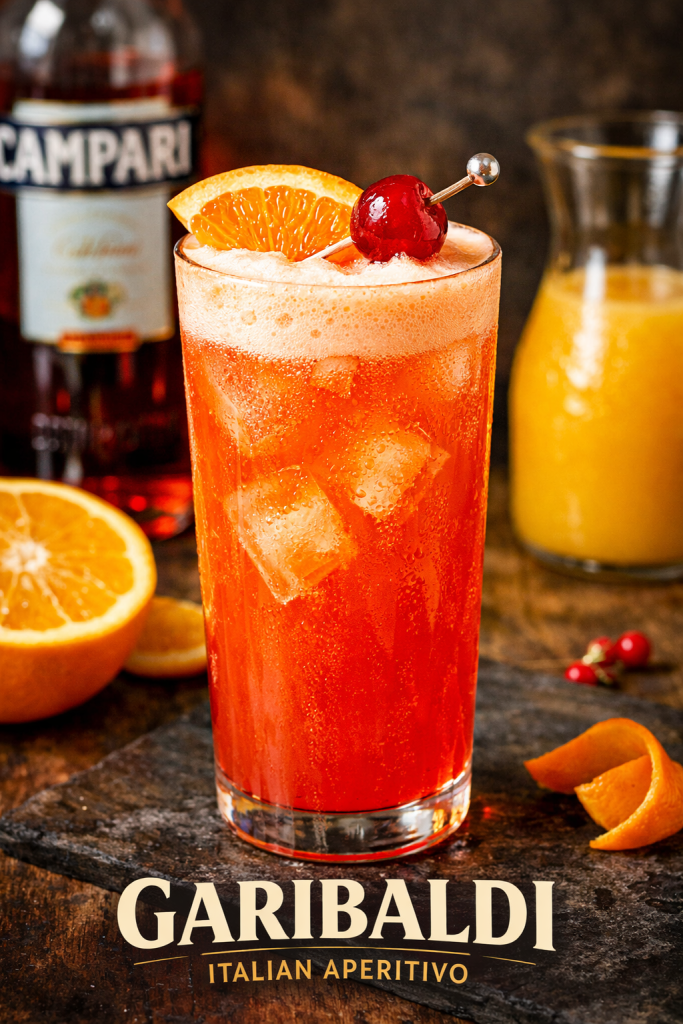
You don't need to be in Italy, nor does it have to be summer, to feel like you've been transported to a sun-drenched piazza in Milan. With just two simple ingredients, you'll have a delightful cocktail that brings the taste of a classic Italian aperitivo to your home, regardless of the season . Behold the Garibaldi—made from just Campari and freshly squeezed orange juice—an iconic cocktail that proves simplicity can be sublime.
The Garibaldi is an Italian aperitivo cocktail that has been captivating drinkers for decades. Its beauty lies in its elegant simplicity: the tang from bright orange juice paired with the distinct, bittersweet notes of Campari creates a complex blend of flavors that is savored by cocktail connoisseurs and casual sippers alike . Unlike its close aperitivo cousin Aperol, Campari features a bolder, more assertive bitterness, making the Garibaldi a drink of beautiful tension—sweet versus bitter, bright versus深沉, simple versus complex.
This isn't just a drink; it's a liquid symbol of Italian unification. The Garibaldi gets its name from Giuseppe Garibaldi, the legendary 19th-century Italian general who played a pivotal role in uniting the country . The cocktail's vivid red-orange hue is said to honor the iconic "Redshirts" worn by Garibaldi's volunteers during the Expedition of the Thousand . More symbolically, the two ingredients represent the unification of Northern and Southern Italy in a single glass: Campari, born in Milan, represents the industrial North, while the bright orange juice evokes the sun-drenched citrus groves of Sicily in the South . Every sip is a toast to history.
The Garibaldi cocktail is the ultimate expression of Italian aperitivo culture. With only two ingredients—Campari and freshly squeezed orange juice—it delivers a perfectly balanced drinking experience that's simultaneously bitter, sweet, refreshing, and complex. The key to an exceptional Garibaldi lies in the quality and preparation of the orange juice: freshly pressed and aerated to create a signature "fluffy," velvety texture that softens the bold edges of the Campari . Served over ice in a highball glass and garnished with a simple orange wedge, this cocktail is the perfect way to stimulate the appetite before dinner or to transport yourself to an Italian summer, no matter where you are .
* Percent Daily Values are based on a 2,000 calorie diet. Your daily value may be higher or lower depending on your calorie needs.
The History: A Toast to Italian Unity
The Garibaldi cocktail is far more than a simple mix of two ingredients; it's a delicious piece of Italian political symbolism served in a highball glass. Named after Giuseppe Garibaldi (1807-1882), the dashing general and national hero who led the military campaign to unify Italy, the drink commemorates his legendary "Expedition of the Thousand" .
The cocktail's vivid reddish-orange color is said to evoke the famous "Redshirts" (Camicie Rosse) worn by Garibaldi's volunteers . More profoundly, each ingredient represents a different part of the newly unified nation. The bitter Campari, originating from Milan in the industrial North, symbolizes Lombardy and Northern Italy . The sweet, sunny orange juice represents Sicily and the agrarian South, where Garibaldi's campaign famously began . Thus, every Garibaldi cocktail is a symbolic union of North and South—a taste of Italian nationhood.
While legends place its origin aboard Garibaldi's ships, mixing Marsala with local orange juice, the cocktail as we know it likely emerged in the mid-20th century . It gained official recognition when the International Bartenders Association (IBA) included it in their list in 1986 . After falling out of fashion for decades, the Garibaldi experienced a spectacular renaissance in 2015, thanks to the Dante bar in New York City, which made a perfectly aerated version its signature drink . In 2024, the IBA officially re-added the Garibaldi to its list of "Contemporary Classics," cementing its status as an enduring icon of mixology .
The Science: The Art of the "Fluffy" Garibaldi
The Garibaldi may be simple, but its preparation involves a clever bit of culinary physics. The key to a truly transcendent Garibaldi is texture—specifically, the aeration of the orange juice.
When fresh orange juice is blended, frothed, or processed at high speed, it incorporates tiny air bubbles. This process, known as aeration, creates a stable foam. The science behind this lies in the juice's composition. Orange juice contains soluble proteins, pectins (a type of carbohydrate), and suspended pulp particles . These compounds act as emulsifiers and stabilizers, surrounding the newly formed air bubbles and preventing them from immediately popping. The result is a "fluffy," velvety, mousse-like consistency that sits beautifully on top of the drink .
This isn't just about looks. The aerated texture dramatically changes the drinking experience. The foam delivers the bright citrus flavor to your palate first, creating a soft, sweet introduction that cushions the bold, bitter impact of the Campari. It makes the cocktail feel more luxurious and complex, transforming two humble ingredients into something truly special . As the experts at Dante NYC discovered, this simple textural trick elevates the Garibaldi from a simple highball to a cocktail masterpiece.