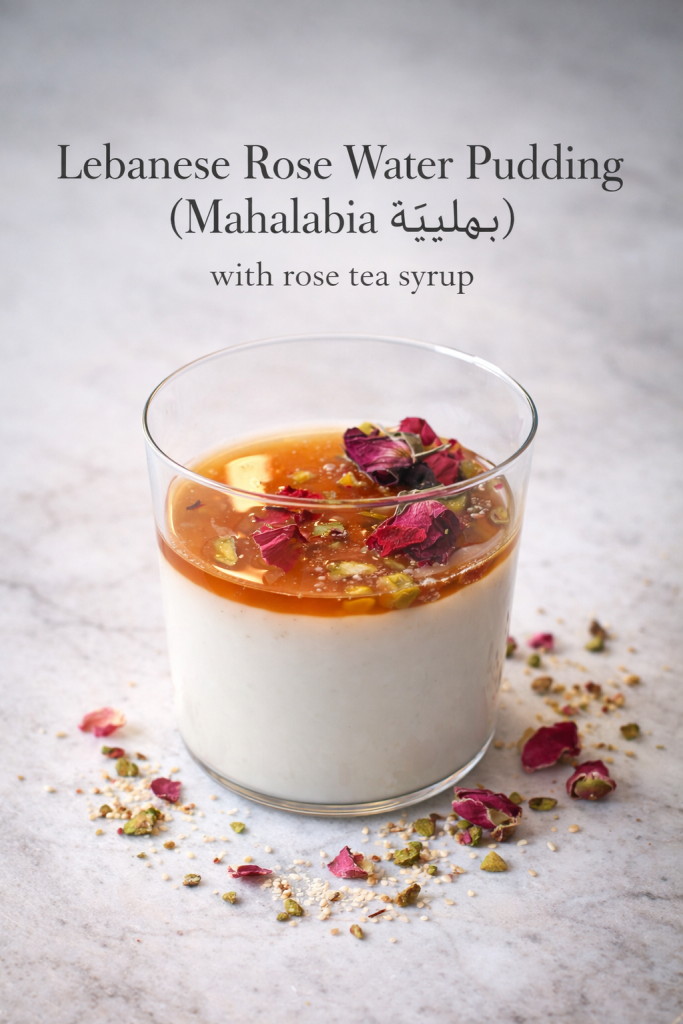
Lebanese Rose Water Pudding (Mahalabia مهلبية) with Rose Tea Syrup
Learn to make authentic Lebanese rose water pudding (Mahalabia) with aromatic rose tea syrup. This creamy Middle Eastern dessert is floral, delicate, and surprisingly easy to make at home.
There are desserts that fill you up, and then there are desserts that transport you. This Lebanese rose water pudding—called Mahalabia (مهلبية) in Arabic—belongs firmly in the second category. It's the dessert my Lebanese friends describe as "the taste of childhood summers in Beirut": cool, creamy, delicately floral, and topped with a pistachio-crowned syrup that stains everything a beautiful shade of blush.
This Lebanese rose water pudding with rose tea syrup takes the classic Middle Eastern milk pudding and elevates it with an extra layer of floral magic. Instead of simple sugar syrup, we're steeping rose tea into the topping, creating a double dose of rose that somehow feels both luxurious and utterly simple. The pudding itself is silky, barely sweet, letting the rose and pistachios do the talking. It's the kind of dessert that makes you close your eyes on the first bite—and reach for a second serving before you've finished the first.
What makes this version special? We're using both rose water and rose tea syrup, building layers of floral flavor that unfold with each spoonful. The technique is foolproof, the ingredients are simple, and the result tastes like it came from a high-end Lebanese restaurant. Whether you're new to Middle Eastern cooking or a seasoned pro, this Mahalabia will become your signature dessert.
Mahalabia's origin story reads like a culinary mystery spanning centuries and empires. According to an old Islamic cookbook from Andalusia, this dessert first appeared in the 7th century . The name itself hints at its ancient roots—it's believed to be named after al-Mahdi, an Abbasid caliph who ruled in the 8th century. Legend has it that his court chef created this delicate milk pudding as a soothing dish for the caliph, who had a particular fondness for light, fragrant sweets. The dessert so pleased him that it became known as "muhallabia," or "something belonging to Muhallab."
But the story likely goes back even further. Ancient Persians had a similar pudding called "shir berenj," a simple rice pudding perfumed with rose water. As Arab empires expanded, they encountered these Persian culinary traditions and adapted them, replacing rice with fine semolina or cornstarch to create the smoother, more elegant texture we know today as Mahalabia. The first formal recipe is actually written in the world's oldest Arabic cookbook, the Kitab al-Ṭabīḫ .
From the royal courts of Baghdad, Mahalabia spread across the Middle East and Mediterranean, each culture adding its own signature. Turks make "muhallebi" and often serve it with cinnamon . Greeks claim "mahallebi" as their own. And in Lebanon, it became the quintessential comfort dessert—served in homes for everyday meals and in restaurants as a refined finale to elaborate feasts. What unites all versions is the same promise: simple ingredients transformed into something transcendent through patience and technique.
Today, Mahalabia appears on iftar tables throughout Ramadan, at Eid celebrations, and at family gatherings where multiple generations gather. Sephardic Jews also consume it to break the fast at Yom Kippur and Shavuot, festivals during which it's customary to consume dairy products . In Turkey, mahalabia is served at weddings to symbolize the sweetness of life to come . It's a dessert that carries memory—every Middle Eastern cook has their grandmother's version in their head, and every spoonful tastes like home.
Mahalabia appears deceptively simple—milk, sugar, cornstarch, rose water—but achieving that perfect, velvety texture requires understanding what's happening at a molecular level. Let's demystify the magic.
Starch Gelatinization: Cornstarch is our thickening agent, and it works through a process called gelatinization. When cornstarch is heated in liquid, its starch granules absorb water and swell, eventually bursting and releasing amylose molecules that form a tangled network. This network traps liquid, transforming our thin milk into a thick, spoonable pudding. But here's the critical part: cornstarch needs to reach about 203°F (95°C) to fully gelatinize. Undercook it, and your pudding will be thin and disappointing. Overcook it, and the starch structure breaks down, thinning again. That's why we cook just until it bubbles and thickens—then stop immediately.
Temperature Control: The most common Mahalabia disaster? Lumps. They form when starch granules clump together before dispersing. This is why we whisk the cornstarch with cold milk first—creating a smooth slurry—and why we add it to the warm (not boiling) milk gradually while whisking constantly. Think of it as introducing the starch molecules politely, not dropping them into a chaotic hot tub.
Rose Water Volatility: Rose water is delicate and temperamental. Its floral compounds are volatile, meaning they evaporate and fade when exposed to high heat. Adding it at the very end, off the heat, ensures those ethereal notes survive into the finished pudding. The same principle applies to the rose tea syrup—we're steeping gently, never boiling aggressively. Because the flavor is delicate, add rose water at the end of cooking so the aroma doesn't disappear .
Setting and Cooling: As Mahalabia cools, the starch network continues to set, creating that firm-yet-creamy texture. But cooling too quickly can cause skin formation or uneven texture. Room temperature cooling followed by refrigeration allows the pudding to set gracefully, like a good night's sleep for dessert. The fat in whole milk and cream also plays a role—fat coats the starch molecules, creating a smoother mouthfeel and preventing that pasty texture you get with skim milk.
WHY THIS ROSE WATER PUDDING RECIPE WORKS
Double rose treatment: Rose tea syrup adds concentrated floral flavor without relying solely on volatile rose water, creating depth and complexity
Perfect texture every time: The precise ratio of cornstarch to liquid, plus careful temperature control, guarantees silky, scoopable pudding
Not too sweet: The pudding is delicately sweetened, letting the floral notes shine while the syrup adds sweetness on top—you control the final sweetness
Make-ahead friendly: Mahalabia actually improves overnight, making it perfect for entertaining and stress-free dinner parties
Restaurant-quality presentation: The rose syrup creates that gorgeous blush-colored crown, and pistachios add color and crunch
Gluten-free naturally: No wheat means everyone can enjoy, and it's easily adapted for dietary restrictions
Foolproof technique: Detailed instructions with visual cues ensure success even for first-time pudding makers
GOOD PAIRING FOOD AND DRINK
Appetizer: Lebanese Stuffed Grape Leaves (Warak Enab) - The savory, lemony brightness of grape leaves stuffed with rice and herbs prepares your palate for the delicate sweetness to come. The contrast between tangy and floral is classic Middle Eastern hospitality.
Main Course: Chicken Shawarma with Garlic Sauce - The warm spices of shawarma—cumin, turmeric, cardamom, allspice—echo the floral notes in the pudding while the garlic sauce (toum) provides a savory, pungent counterpoint. It's a complete taste of the Levant.
Side Dish: Lebanese Fattoush Salad - The tangy sumac, fresh vegetables, and crispy pita chips cleanse the palate beautifully between bites of rich, creamy pudding. The bright acidity cuts through the dessert's richness perfectly.
Dessert: This is your dessert! For a Middle Eastern dessert spread, serve alongside Baklava for textural contrast—the flaky, nutty, honey-soaked pastry against the silky, floral pudding is a match made in heaven.
Cocktail: Rose Gin and Tonic - Muddle fresh rose petals or add a splash of rose water to a classic G&T with a cucumber ribbon. The botanical notes harmonize perfectly with the pudding, and the bubbles provide refreshing contrast.
Non-Alcoholic Drink: Mint Lemonade - Fresh mint and tart lemon cut through the pudding's creaminess while complementing the floral notes. The brightness wakes up your palate between luxurious spoonfuls.
Dietary:
Gluten-Free, Halal, High Calcium, Kosher, Low Sodium, Vegetarian
Description
This authentic Lebanese rose water pudding (Mahalabia) is impossibly smooth, delicately sweet, and topped with a fragrant rose tea syrup and crunchy pistachios. A simple, elegant Middle Eastern dessert that tastes like heaven.
Ingredients
For the Rose Water Pudding (Mahalabia)
2cups whole milk (full-fat is essential for creamy texture; do not use skim)
1/2cup heavy cream (for extra richness; can substitute with more whole milk)
1/4cup granulated sugar (adjust to taste, up to ⅓ cup for sweeter)
3tablespoons cornstarch (level tablespoons, not heaping)
2teaspoons rose water (quality matters—look for food-grade Middle Eastern brands)
1/4teaspoon vanilla extract ((optional, but rounds the flavor beautifully)
For the Rose Tea Syrup
1/2cup water
1/4cup granulated sugar
1tablespoon dried rose petals (food-grade, or 1 rose tea bag)
1teaspoon rose water (add at the end, off heat)
For Garnish
2tablespoons crushed pistachios (unsalted, raw or lightly toasted)
Additional dried rose petals (optional, for visual appeal)
Instructions
1
Step 1: Prepare Your Ramekins
Arrange 4 small ramekins or serving glasses (6-ounce size) on a small tray or baking sheet. Having them ready ensures you can pour the pudding immediately once it's done—this mixture sets quickly, so speed matters
2
Step 2: Make the Cornstarch Slurry
In a small bowl, combine the cornstarch with ¼ cup of the cold milk (taken from your measured 2 cups). Whisk thoroughly until completely smooth with absolutely no lumps. This slurry is your insurance policy against lumpy pudding. Set aside.
3
Step 3: Heat the Milk Base
In a medium saucepan, combine the remaining milk (1¾ cups), heavy cream, and sugar. Place over medium heat and warm gently, stirring occasionally with a whisk or wooden spoon. Heat until the sugar dissolves and small bubbles appear around the edges of the pan—about 3-4 minutes. Do not let it come to a full boil yet.
4
Step 4: Thicken the Pudding
Give your cornstarch slurry a quick re-whisk (it settles fast), then pour it into the warm milk mixture in a steady stream while whisking constantly. This is not the time to walk away.
Continue whisking over medium heat. Within 3-5 minutes, you'll notice the mixture beginning to thicken. Keep whisking—it's meditative, I promise. When it starts to bubble gently and visibly thickens to the consistency of heavy cream, cook for exactly 1 minute more. This ensures the cornstarch fully gelatinizes. The mixture should be thick but still pourable; it will continue setting as it cools.
Visual cue: The pudding should coat the back of a spoon and leave a clear path when you run your finger through it.
5
Step 5: Add the Rose Water
Remove the pan from heat immediately. Stir in the rose water and vanilla extract. Taste carefully—the flavor should be present but not overpowering. Remember, chilling mutes flavors slightly, so aim for a bit more rose than you think you want.
6
Step 6: Pour and Chill
Working quickly but carefully, pour the pudding into your prepared ramekins, dividing evenly. Tap each ramekin gently on the counter 2-3 times to release any air bubbles that might have formed.
Let them cool to room temperature on the counter (about 30 minutes). Then cover each ramekin with plastic wrap, pressing the wrap directly onto the surface of the pudding to prevent a skin from forming. Refrigerate for at least 4 hours, preferably overnight. The patience is worth it.
7
Step 7: Make the Rose Tea Syrup
While the pudding chills, prepare the syrup. In a small saucepan, combine water, sugar, and dried rose petals (or tea bag). Bring to a gentle simmer over medium heat, stirring until sugar dissolves completely.
Reduce heat to low and let steep for 10 minutes. The liquid will take on a beautiful pinkish hue and that intoxicating rose aroma. Remove from heat, stir in the additional rose water, and let cool completely to room temperature. Strain out petals if desired (or leave them for a rustic look). The syrup will thicken slightly as it cools.
8
Step 8: Serve with Elegance
To serve, you have two options:
Traditional style: Run a thin knife around the edge of each ramekin and invert onto a small plate. The pudding should release cleanly.
Modern style: Serve directly in pretty glass cups or dessert glasses to show off the layers.
Spoon rose tea syrup generously over the top, letting it cascade down the sides. Sprinkle with crushed pistachios and a few dried rose petals. Serve cold.
Nutrition Facts
Servings 4
Amount Per Serving
Calories285kcal
% Daily Value *
Total Fat14g22%
Saturated Fat8g40%
Cholesterol45mg15%
Sodium65mg3%
Total Carbohydrate34g12%
Dietary Fiber0.5g2%
Sugars28g
Protein6g12%
Vitamin A 320 IU
Calcium 260 mg
Vitamin D 2 IU
* Percent Daily Values are based on a 2,000 calorie diet. Your daily value may be higher or lower depending on your calorie needs.
Note
Rose Water Quality: Not all rose waters are created equal. Middle Eastern brands like Cortas, Al Wadi, or Mymouné are reliable and food-grade. "Quality matters," says Yumna Jawad, founder of Feel Good Foodie. "Look for 100 percent pure steam-distilled rose water, with no added alcohol or synthetic fragrance. My favorite brand is Cortas Rose Flower Water from Lebanon" . Avoid "rose extract" or "rose flavoring" found in baking aisles—they're often synthetic and harsh. Good rose water should smell like a garden after rain, not like perfume counter. The distillation of rose petals is thought to have originated thousands of years ago in Iran, where 90% of the world's rosewater is still produced .
Dairy Options: For a lighter version, use all whole milk and omit cream. The texture will be slightly less luxurious but still lovely. For a dairy-free version, full-fat oat milk or canned coconut milk (not light) work beautifully. If using plant milk, add an extra teaspoon of cornstarch to compensate for the lack of dairy fat. Coconut milk creates a beautiful tropical variation.
Sugar Adjustments: Traditional Mahalabia is delicately sweet, letting the rose shine. If you have a serious sweet tooth, increase sugar to ⅓ cup in the pudding. Remember that the rose syrup adds significant sweetness, so taste as you go.
No Lumps Guarantee: The two most common lump culprits:
Adding cornstarch directly to hot milk (always make a slurry first)
Not whisking constantly during thickening Stay vigilant during those 3-5 minutes. If you see lumps forming, whisk vigorously—you can often break them up. If all else fails, strain the hot pudding through a fine-mesh sieve before pouring into ramekins.
Make-Ahead Magic: Mahalabia is the perfect party dessert because it MUST be made ahead. Prepare up to 2 days in advance, keeping covered in the refrigerator. The texture actually improves as it sets. Add syrup and pistachios just before serving to keep pistachios crunchy.
Storage Guidelines:
Pudding: Covered in the refrigerator, Mahalabia keeps for 3-4 days
Syrup: Stored separately in an airtight container, keeps for 2 weeks in the refrigerator
Do not freeze—the starch structure breaks down and texture becomes grainy
Pistachio Prep: For the brightest green color, use raw pistachios and crush them yourself just before serving. Pre-chopped pistachios often include brown bits and have faded color. To crush, place pistachios in a zip-top bag and gently tap with a rolling pin—you want pieces, not powder.
Serving Temperature: Mahalabia should be served cold, straight from the refrigerator. The contrast between cool pudding and room-temperature syrup is delightful.
Variation - Orange Blossom Mahalabia: Substitute orange blossom water for rose water in both pudding and syrup. Use a strip of orange zest in the syrup instead of rose petals. Completely different, equally enchanting.
Special Occasion Tip: For an elegant dinner party, serve in clear glass cups or wine glasses to show off the beautiful layers—white pudding, blush syrup, green pistachios. Stunning presentation with zero extra effort.
Keywords:
Lebanese rose water pudding, Mahalabia recipe, مهلبية, Middle Eastern milk pudding, rose water dessert, rose tea syrup, Lebanese dessert, Arabic pudding, muhallebi recipe, how to make Mahalabia, Middle Eastern sweets, floral dessert, pistachio topping, cornstarch pudding, traditional Lebanese dessert, easy Middle Eastern dessert, gluten-free pudding, rose flavored pudding, creamy milk pudding, restaurant style dessert, make ahead dessert, Ramadan dessert, Eid recipe, Levantine cuisine,
Mahalabia travels across the Middle East and beyond, picking up local accents along the way. Understanding these variations deepens your appreciation for this humble pudding.
Lebanese Mahalabia: The version we're making today—silky, firm enough to unmold, scented with rose water, and topped with pistachios and syrup. Lebanese cooks often use a combination of cornstarch and rice flour for a slightly different texture. It's a staple at iftar during Ramadan and at Easter celebrations among Lebanese Christians.
Turkish Muhallebi: Often made with rice flour instead of cornstarch, giving a slightly grainier but equally beloved texture. Turkish muhallebi is frequently served with a dusting of cinnamon or ground pistachios. A baked variation, known as "fırın muhallebi," develops a golden crust on top while maintaining a soft center . The famous "tavuk göğsü" (chicken breast pudding) is a variation that actually includes shredded chicken breast—sounds bizarre, tastes incredible, and dates back to Ottoman palace cuisine.
Greek Mahallebi: Typically looser in consistency, served in bowls and eaten with a spoon. Often flavored with mastic (a resin with a unique piney flavor) or rose water, and topped with cinnamon and walnuts rather than pistachios. It's a common sight in Greek bakeries and homes.
Egyptian Mahalabia: Sometimes made with semolina for added texture, and often served with a drizzle of honey instead of syrup. Egyptians also make a savory version with chicken broth called "muhallabia" that's completely different—a testament to how names travel.
Israeli Malabi: This famous rosewater pudding is very popular with locals and tourists. It can be found on the menu of several restaurants, topped with a pink sugar syrup flavored with rose water. In addition, part of the milk is replaced by 35% cream for an even smoother texture. Finally, some prefer to consume malabi topped with a mixture of coconut and coarsely chopped pistachios .
Iraqi Muhallabia: Often includes ground rice and is perfumed with both rose and orange blossom water. Topped with ground almonds and sometimes a sprinkle of cardamom.
Ramadan and Eid: Across the Middle East, Mahalabia appears on iftar tables throughout Ramadan. After a day of fasting, this cool, gentle dessert soothes the stomach and satisfies the sweet craving without overwhelming. It's light enough to enjoy after a heavy meal but special enough for celebration. During Eid al-Fitr, it's often served alongside ka'ak (date-filled cookies) and Arabic coffee.
Weddings and Celebrations: In some Lebanese traditions, Mahalabia is served at weddings and engagement parties, symbolizing the sweetness and smoothness of the new union. The white color represents purity, and the rose fragrance represents love. In Turkey, it's served at weddings to symbolize the sweetness of life to come .
Mourning and Comfort: Like many milk puddings around the world, Mahalabia is also considered "comfort food" for the sick or grieving. It's easy to digest, nourishing, and the floral fragrance is believed to lift spirits.
The Rose Tradition: Roses have been cultivated in the Middle East for millennia. The Bekaa Valley in Lebanon and the mountains of Iran (especially Qamsar near Kashan) are still known for their rose harvests, where petals are traditionally distilled into rose water using copper stills and methods unchanged for centuries . In the Khasan region of Iran, a rosewater festival occurs annually from May through June to celebrate the harvest (Golab-Giri) . That bottle of rose water in your pantry connects you to an unbroken chain of culinary tradition stretching back over a thousand years.
Family Memory: In Lebanese households, Mahalabia is often the first dessert children learn to make. It's simple enough for small hands to help stir, and the magic of liquid transforming into solid feels like kitchen sorcery. Layali Lubnan is one of the most common made-at-home desserts in Lebanon; it's often made to celebrate holidays and special occasions and is considered a simple and cheap dessert compared to other traditional desserts . Every Lebanese cook has their grandmother's version in their memory—some make it thicker, some thinner, some add more rose, some use orange blossom. But every version carries love.