Nutrition Facts
- Amount Per Serving
- Calories 185kcal
- % Daily Value *
- Sodium 150mg7%
- Total Carbohydrate 11g4%
* Percent Daily Values are based on a 2,000 calorie diet. Your daily value may be higher or lower depending on your calorie needs.
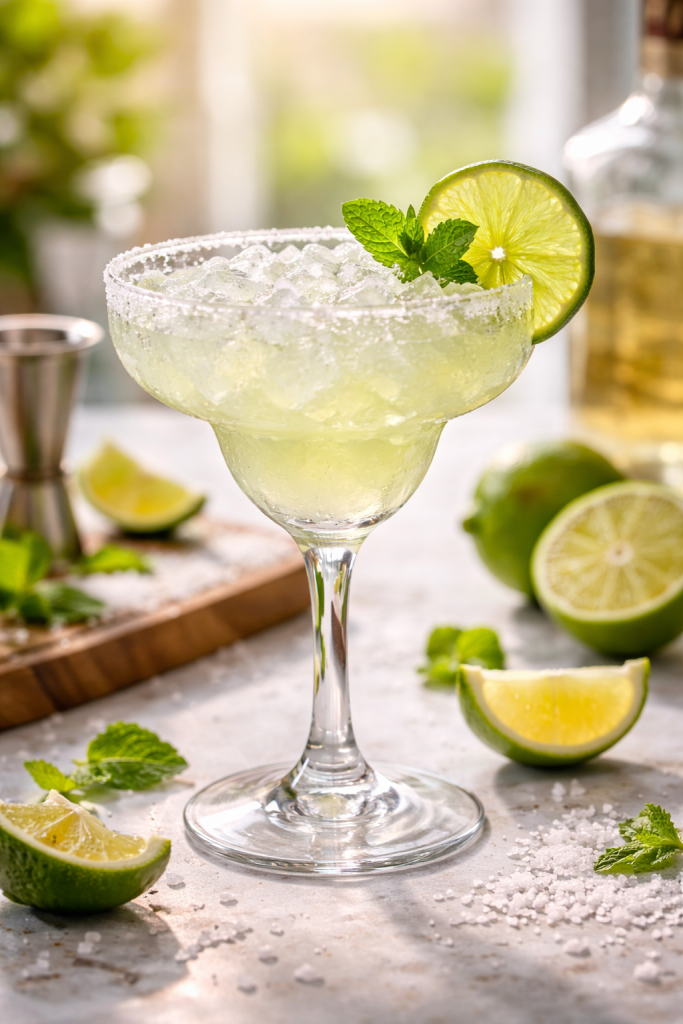
Is there any cocktail more instantly transportive than a perfectly crafted Margarita? One sip—with that bright burst of lime, the earthy agave warmth of tequila, and the gentle orange sweetness—and you're suddenly somewhere warmer, somewhere with salt air and sunshine, even if you're just sitting on your back porch. The classic Margarita recipe has earned its place among the world's most beloved cocktails for good reason: it's simple, refreshing, and infinitely greater than the sum of its parts.
But here's the thing about simplicity: it leaves no room for error. A great Margarita is a study in balance—that elusive sweet-sour-spirit harmony that separates transcendent cocktails from merely good ones. This version, built on the golden ratio of 2:1:1 (two parts tequila, one part orange liqueur, one part fresh lime juice), delivers that balance every single time. No sour mix, no shortcuts, no cloying sweetness—just the bright, bracing, beautifully balanced Margarita you deserve.
I've tested more variations than I care to count, from the frozen machines of beach bars to the meticulous craft cocktail lounges, and this recipe represents the sweet spot: accessible enough for a Tuesday night, impressive enough for a Cinco de Mayo celebration, and endlessly adaptable to your personal tastes. Let's dive into the history, the science, and the technique behind this iconic drink.
The Margarita's origins are about as clear as... well, a well-shaken Margarita. That is to say, gloriously murky and the subject of passionate debate among cocktail historians. What we know for certain is that this drink emerged somewhere along the Mexico-U.S. border in the late 1930s or early 1940s, but who deserves the credit remains contested .
One compelling theory traces the Margarita to the brandy daisy, a classic 19th-century cocktail family that combined spirit, citrus, and liqueur. "Margarita" is, after all, Spanish for "daisy." Cocktail historian David Wondrich points to an account from 1936 when an Iowa newspaper editor discovered a tequila-based cocktail in Tijuana that predates most other origin stories . During Prohibition, Americans flocked to Mexico for alcohol, and it's entirely plausible that some inventive bartender simply substituted tequila for the brandy in a daisy and made history .
Then there are the charming creation myths. Carlos "Danny" Herrera claimed he invented the Margarita in 1938 at his Rancho La Gloria restaurant between Tijuana and Rosarito for Marjorie King, a Ziegfeld dancer allergic to all spirits except tequila . Hussong's Cantina in Ensenada insists bartender Don Carlos Orozco created it in 1941 for Margarita Henkel, a German patron . Francisco "Pancho" Morales said he invented it on July 4, 1942, at Tommy's Place Bar in Juárez . And Dallas socialite Margarita Sames claimed she concocted it for friends at her Acapulco vacation home in 1948—guests who supposedly included Tommy Hilton, who then brought it to his hotel chain .
The first known publication of a Margarita recipe appeared in the December 1953 issue of Esquire magazine, calling for an ounce of tequila, a dash of triple sec, and the juice of half a lime or lemon . By the 1970s, with Jimmy Buffett's "Margaritaville" cementing its place in popular culture, the drink had become an American institution. The frozen Margarita machine, invented by Dallas restaurateur Mariano Martinez in 1971 using a repurposed soft-serve ice cream machine, launched a whole new way to enjoy it .
Today, the Margarita stands as the most popular tequila-based cocktail in the world, a testament to the power of three simple ingredients in perfect harmony.
Link: Why the Classic Margarita Remains a Perfect Cocktail - Food & Wine
Understanding what happens in that cocktail shaker transforms you from a recipe-follower into a true mixologist. The Margarita, for all its simplicity, is a fascinating study in flavor chemistry.
The Flavor Triad: Balance Through Antagonism
A classic Margarita pits three powerful forces against each other: the earthy, vegetal notes of tequila (with its 600+ volatile aromatic compounds including esters and terpenes), the bright acidity of fresh lime juice (pH around 2.0–2.4), and the sweet, orange-flavored complexity of triple sec or Cointreau. Left unmodulated, these elements can clash—acidity stings, alcohol numbs, and sweetness can flatten complexity. But when properly balanced, they create something magical .
The magic happens through a process called flavor antagonism, where certain compounds suppress or enhance our perception of others. Research has shown that low concentrations of sodium chloride—which brings us to that salt rim—can suppress sour perception by up to 35% while simultaneously enhancing our sensitivity to sweet and umami notes . This means the lime's tartness feels brighter and more refreshing, not harsher, while the tequila's roasted agave notes gain clarity instead of receding behind acidity.
Why Shaking Matters (and How Much)
Temperature and dilution are critical variables. When you shake a cocktail with ice, you're not just chilling it—you're introducing controlled dilution that opens up the flavors. A cocktail shaker with ice will bring a drink down to approximately -7°C (19°F) after about 20 seconds of vigorous shaking, which is as cold as it will get . That 20-second shake also introduces the ideal amount of water (about 20-25% of the final volume), which "unlocks" aromatic compounds and smooths the ethanol burn.
Stirring, by contrast, takes about twice as long to achieve the same temperature and dilution—about 40 seconds . For a spirit-forward, citrus-heavy drink like the Margarita, shaking is superior because it more effectively chills and dilutes while also aerating the mixture slightly, creating a pleasing texture.
The Salt Rim: Neuromodulation in a Glass
That salt rim isn't just decorative—it's a precision tool for flavor modulation. When sodium ions interact with your taste receptors, they trigger dopamine release in the brain's pleasure centers. Functional MRI studies show that when salt accompanies sour or bitter stimuli, activity increases in the orbitofrontal cortex—the brain's "pleasure valuation center"—more than either stimulus alone .
Salt also physically alters the volatility of aromatic compounds. It helps "lift" fruity esters like ethyl acetate (pear, apple) and isoamyl acetate (banana) from the liquid into the headspace above the glass, making them more detectable to your olfactory receptors, while slightly suppressing harsher fusel alcohols . This dual effect is why a properly salted Margarita smells fruitier and tastes smoother than an unsalted one—even with identical ingredients.
Link: A Critical Review of the Flavor Chemistry of Tequila - ACS Publications
Link: Why A Salted Rim Gives Any Cocktail A Major Upgrade - Tasting Table
One Appetizer: Fresh guacamole with house-made tortilla chips
The creamy richness of avocado provides the perfect counterpoint to the Margarita's bright acidity. The fat coats your palate between sips, allowing the lime and tequila to taste fresh each time. Add a sprinkle of sea salt and you're echoing that salted rim in edible form.
One Main Course: Fish tacos with cabbage slaw and crema
Grilled or beer-battered fish, nestled in warm corn tortillas with a tangy slaw and cooling crema, mirrors the Margarita's balance of bright and rich elements. The citrus in the slaw echoes the lime, while the crema's richness stands up to the tequila.
One Side Dish: Mexican street corn (elote)
Grilled corn slathered in crema, cotija cheese, chili powder, and lime—it's essentially the savory cousin of your cocktail. The lime and chili echo the drink's flavor profile, while the cheese and crema provide a creamy contrast.
One Dessert: Lime or key lime pie
A natural progression from cocktail to dessert, lime pie captures the same sweet-tart balance in solid form. The buttery crust and silky filling echo the Margarita's structure—spirit (butter), citrus, and sweetness. Add a sprinkle of salt on the crust for continuity .
One Cocktail: Paloma
If you're already in tequila territory, the Paloma (tequila, grapefruit soda, lime) offers a lighter, more effervescent take on similar flavors. It's the perfect aperitif before transitioning to Margaritas, or a lower-proof option for pacing yourself.
One Non-Alcoholic Drink: Sparkling limeade with a salted rim
Fresh lime juice, simple syrup, and sparkling water, served in a salt-rimmed glass. It captures all the refreshment of a Margarita without the alcohol, making it perfect for designated drivers or daytime gatherings .
This classic Margarita recipe delivers the perfect balance of sweet, sour, and spirit. Made with just three ingredients and a salted rim, it's the refreshing cocktail you'll come back to again and again.
* Percent Daily Values are based on a 2,000 calorie diet. Your daily value may be higher or lower depending on your calorie needs.
Pro Tips for Success:
Make-Ahead Instructions:
You can batch Margaritas for parties by combining tequila, orange liqueur, and lime juice in a pitcher (minus the ice). Store in the refrigerator for up to 24 hours. When ready to serve, shake individual portions with ice, or pour the batch over a large block of ice in a punch bowl and let guests serve themselves. Add the salt rim fresh for each glass.
Storage:
Margaritas are best enjoyed immediately. The mixture (without ice) can be refrigerated for up to 24 hours, but fresh lime juice loses its brightness over time. Do not freeze.
Substitutions:
Troubleshooting:
Ingredient Sourcing:
Look for 100% agave tequila—it will say so on the bottle. For orange liqueur, Cointreau is widely available; Combier and Pierre Ferrand Dry Curaçao are excellent alternatives. For limes, choose fruits that are heavy for their size—they're juicier.
Regional Variations
While the classic Margarita reigns supreme, regional variations offer fascinating twists:
Cultural Traditions
The Margarita has become inseparable from certain celebrations. Cinco de Mayo sees Americans consume more tequila than any other day of the year, much of it in Margarita form. National Margarita Day (February 22) has gained traction as an unofficial holiday. And summer gatherings from Memorial Day to Labor Day practically demand a pitcher of Margaritas on the table.
In Mexico, interestingly, the Margarita is seen as more of a tourist drink or special occasion cocktail rather than an everyday refreshment. You're more likely to encounter a Paloma (tequila with grapefruit soda) in daily life, or simply enjoy tequila with sangrita—a spicy, citrusy chaser .
Technique Deep Dive: The Art of Shaking
That 20-second shake isn't arbitrary—it's the result of understanding heat transfer and dilution. Ice at -18°C (0°F) has significant cooling capacity. When you shake, three things happen:
The ideal Margarita should have about 20-25% dilution from melted ice. Shaking for 15-20 seconds with good, large ice cubes achieves this perfectly. Shake too little and the drink is warm and harsh; shake too long and it becomes watery .
Personal Story
I learned to make Margaritas from an old bartender in Puerto Vallarta who used no jigger, no recipe—just a knowing pour and a squeeze. When I asked him his secret, he laughed and said, "The lime tells you when it's right." I've spent years trying to understand what he meant, and I think it's this: when you've made enough Margaritas, you can smell the balance. The lime shouldn't scream, and the tequila shouldn't hide. They should dance together. This 2:1:1 ratio is my way of translating that intuition into something measurable—a starting point for your own journey toward knowing when it's right.