Nutrition Facts
- Amount Per Serving
- Calories 245kcal
- % Daily Value *
- Sodium 3mg1%
- Total Carbohydrate 12g4%
- Sugars 2g
* Percent Daily Values are based on a 2,000 calorie diet. Your daily value may be higher or lower depending on your calorie needs.
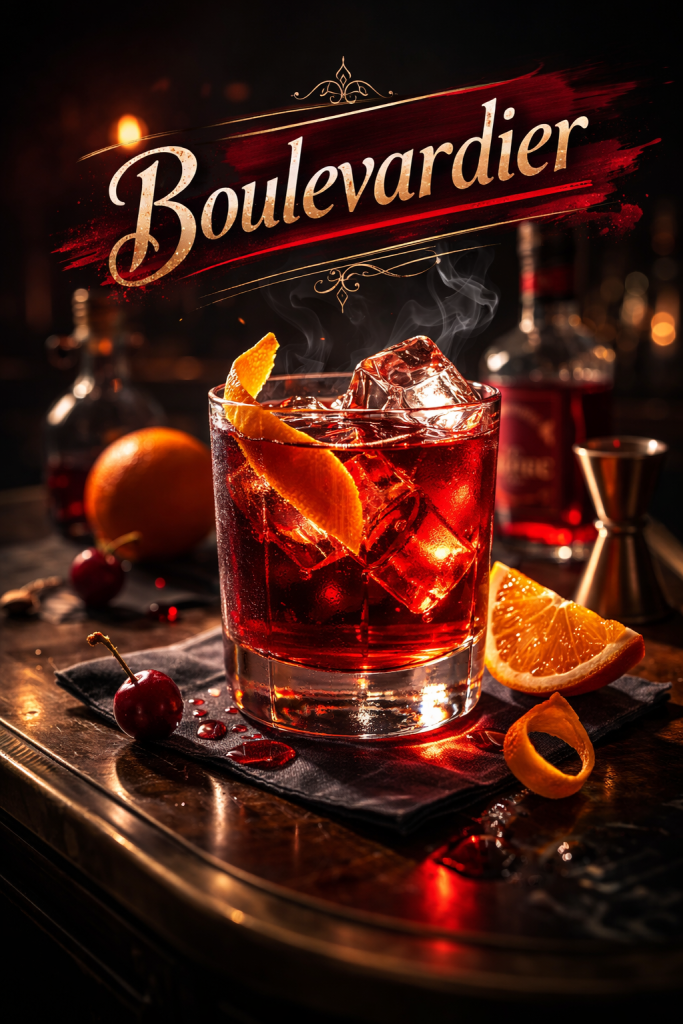
Have you ever taken a sip of a Negroni and thought, "This is wonderful, but I wish it had the warm, oaky embrace of bourbon"? If so, let me introduce you to your new favorite cocktail. The boulevardier cocktail is everything you love about the Italian classic—that beautiful dance of bitter and sweet—transformed into something deeper, richer, and unmistakably American.
Imagine this: you're settling into a leather armchair on a cool autumn evening, jazz playing softly in the background, and in your hand is a glass of something the color of a ruby sunset. The first sip hits you with the bold warmth of whiskey, followed immediately by the complex bitterness of Italian amaro, all rounded out by the herbal sweetness of vermouth. This is the boulevardier experience .
What makes this version special? We're going beyond the basic recipe to explore not just how to make it, but why each element matters. We'll uncover the cocktail's glamorous Parisian origins, dive into the science of balancing bitter and sweet, and give you professional techniques to craft the perfect boulevardier every single time. Whether you're a seasoned home mixologist or just discovering the world of classic cocktails, this guide will transform how you think about this sophisticated sipper.
The story of the boulevardier cocktail reads like a F. Scott Fitzgerald novel—full of expatriate glamour, literary aspirations, and the cultural cross-pollination that defined the 1920s .
Our story begins at Harry's New York Bar in Paris, a legendary establishment that became a home away from home for American expatriates fleeing Prohibition. The bar's owner, Harry McElhone, was a Scottish-born bartender with a genius for capturing the spirit of his era in a glass. In 1927, he published "Barflies and Cocktails," a delightful collection of recipes and anecdotes from the colorful characters who frequented his establishment .
Tucked away in an essay titled "Cocktails About Town" by Arthur Moss, not in the main recipe list, appears the first mention of the boulevardier. It's attributed to Erskine Gwynne, an American-born writer, Vanderbilt nephew, and socialite who had founded a monthly magazine in Paris called "Boulevardier." The magazine, which ran from 1927 to 1932, was described as "fast but clean" and positioned itself as essential reading "before, between and after cocktails" .
The original recipe called for equal parts: one-third Campari, one-third Italian vermouth, and one-third bourbon whiskey . Interestingly, a very similar cocktail called the "Old Pal" appeared in the same essay, differentiated only by its use of Canadian Club whisky .
Despite this promising debut, the boulevardier vanished from cocktail books for nearly 80 years. While its cousin the Negroni rose to fame in the 1950s and earned a spot on the inaugural IBA list in 1961, the boulevardier remained forgotten . It took the craft cocktail revival of the late 2000s to resurrect this gem. Cocktail historian Ted Haigh, writing as "Dr. Cocktail," rediscovered the recipe and published it in a 2007 issue of Imbibe magazine, sparking a renaissance [citation:12]. By the mid-2010s, the boulevardier had reclaimed its rightful place among the world's great cocktails, and in 2020, it was officially added to the IBA's list of "Unforgettables" [citation:14].
At first glance, the boulevardier appears deceptively simple—three ingredients, one technique. But within that simplicity lies a masterpiece of sensory balance that professional bartenders spend years mastering.
The boulevardier is built on three pillars: spirit, bitter, and aromatized wine. Each plays an essential role.
Whiskey provides the foundation. Bourbon, with its notes of vanilla, caramel, and oak from new charred American barrels, brings warmth and sweetness that tame Campari's aggression. Rye whiskey, with its higher rye content, offers a spicier, drier counterpoint . The choice of whiskey fundamentally changes the cocktail's character—bourbon creates a rounder, sweeter drink, while rye delivers a more assertive, complex experience.
Campari is the soul of bitterness. This vibrant red Italian bitter, with its secret recipe of herbs, spices, and fruit, clocks in at around 24% ABV and contains 180-220 g/L of residual sugar . Its bitterness comes from compounds like those found in gentian root, cinchona, and rhubarb . But Campari isn't just bitter—it carries notes of orange peel, cherry, clove, and cinnamon that add incredible complexity.
Sweet vermouth is the mediator. This aromatized wine, typically around 15-18% ABV, brings herbal complexity and crucial sweetness that bridges the gap between whiskey and Campari. A quality vermouth like Carpano Antica Formula, with its vanilla and caramel notes and higher residual sugar (around 35%), can transform a good boulevardier into an unforgettable one .
The original 1927 recipe called for equal parts—1:1:1. But most modern recipes, including the IBA standard, call for a 1.5:1:1 ratio (1½ ounces whiskey to 1 ounce each Campari and vermouth) . Why the change?
This adjustment acknowledges whiskey's bold personality. Bourbon and rye are typically 40-50% ABV, significantly higher than gin (the Negroni's base spirit). To stand up to that alcohol intensity and allow the whiskey's character to shine through without being overwhelmed by Campari's bitterness, we need a heavier hand with the base spirit .
Some bartenders go even further, preferring a 2:1:1 ratio for a truly whiskey-forward expression . The beauty of the boulevardier is that you can adjust the ratio to suit your palate. Start with the classic 1.5:1:1 and experiment from there.
Perhaps the most overlooked science in cocktail making is dilution. When you stir a boulevardier with ice, you're not just chilling it—you're carefully introducing water that transforms the drink.
Proper dilution (targeting about 25-30% of the cocktail's original volume) serves multiple purposes . It softens the alcohol's burn, allowing flavors to emerge. It helps bitter compounds integrate rather than dominate. And it creates a more pleasant mouthfeel .
Temperature matters too. At very cold temperatures (around 4°C or 39°F), our perception of sweetness drops by about 30%, while bitterness perception decreases by only 12% . This means an over-chilled cocktail can taste disproportionately bitter. Allowing the drink to warm slightly as you sip reveals its true balance .
This is why large ice cubes are essential—they melt more slowly, giving you controlled dilution and allowing the cocktail to evolve gracefully from first sip to last .
The boulevardier's bold, bittersweet profile makes it remarkably food-friendly. Here are our expert-recommended pairings.
Learn to craft the perfect boulevardier cocktail with our comprehensive guide. This whiskey-forward cousin of the Negroni delivers a perfectly balanced blend of bitter, sweet, and spirit-forward flavors that cocktail enthusiasts adore. With just three ingredients and five minutes, you'll create a drink that tastes like it came from a world-class cocktail bar.
* Percent Daily Values are based on a 2,000 calorie diet. Your daily value may be higher or lower depending on your calorie needs.
There's something almost meditative about making a boulevardier. Unlike the frantic energy of a shaken cocktail, stirring a boulevardier demands a kind of quiet focus. The gentle clink of ice against glass, the gradual transformation of three separate ingredients into a unified whole, the way the color deepens to a perfect ruby as the chill sets in—it's a ritual that connects you to generations of drinkers before you.
I discovered this cocktail during a particularly harsh winter a few years ago. Snow was falling outside, and I had just finished reading Ernest Hemingway's "A Moveable Feast," that glorious memoir of Paris in the 1920s. The idea of ordering a drink at Harry's New York Bar, of sitting where Fitzgerald and Joyce and Picasso had sat, felt impossibly romantic. So I looked up a recipe for the boulevardier—Erskine Gwynne's drink, born in that very era—and made one.
The first sip was a revelation. That combination of warm bourbon, bitter Campari, and sweet vermouth tasted like nostalgia for a time I never experienced. It was sophisticated and approachable, challenging and comforting all at once. Now, whenever I make a boulevardier, I'm transported. I'm no longer in my kitchen; I'm in 1920s Paris, watching the world's most creative minds gather around a bar, sharing stories and cocktails.
That's the power of a great cocktail. It's more than the sum of its ingredients—it's a time machine, a story, and an experience, all in one glass.
Source: Imbibe Magazine - "History Lesson: The Boulevardier" by Ted Haigh
Link: https://imbibemagazine.com/the-history-of-the-boulevardier-co*cktail/
Source: NIH/PMC - "Tracing the Volatilomic Fingerprint of the Most Popular Italian Fortified Wines" (2023)
Link: https://pmc.ncbi.nlm.nih.gov/articles/PMC10217346/
Source: Food52 - "Which Alcohols Should Be Refrigerated (& Why)?"
Link: https://food52.com/story/16656-which-alcohols-should-be-refrigerated-why