
Introduction
Close your eyes and imagine this: you’re walking down a bustling street in Taipei or Shanghai, the air thick with the mingled aromas of soy sauce, star anise, and something deeper—a smoky, tea-scented fragrance that stops you in your tracks. There, nestled in a simmering pot tended by an elderly vendor, you see them. Eggs with shells cracked like ancient porcelain, revealing glimpses of the deep mahogany treasure within. That first bite—savory, complex, and impossibly fragrant—is a revelation you never forget .
Those are Chinese tea eggs, or 茶叶蛋 (chá yè dàn), one of the most beloved street foods across China and Taiwan. And here’s the best kept secret: they’re surprisingly easy to make at home.
Today, I’m sharing my foolproof method for creating tea eggs with that perfect marble pattern and deep, layered flavor that penetrates all the way to the yolk. We’ll crack, simmer, and steep them in a magical blend of black tea, soy sauce, and warm spices until they’re incredibly flavorful and absolutely gorgeous. The key? Patience. The overnight steep is where the real magic happens. Let’s bring that street food experience into your kitchen.
The History: From Ming Dynasty to Modern Marvel
Ancient Roots, Evolving Recipe
The exact origins of tea eggs are lost to history, but scholars have traced written evidence back to the Ming dynasty (1368-1644). The earliest known recipe appears in Song Xu’s Song’s Health-Building Recipes (《宋氏养生部》) from the fifteenth century, describing a method for “simmered eggs” that closely resembles today’s techniques . By the Qing dynasty, the great gourmet Yuan Mei had included a precise recipe in his famous Suiyuan Menu (《随园食单》): “One hundred eggs, one tael of salt, cook with coarse tea leaves for the time it takes two sticks of incense to burn” .
Some food historians trace the lineage even further back to the Northern Song dynasty (960-1127), when night markets in the capital city of Kaifeng sold a fermented egg dish called “熝糟蛋” (lù zāo dàn) that may have been a precursor .
The Street Food Revolution
Tea eggs truly came into their own as street food in the late nineteenth and early twentieth centuries. A 1909 illustration in the Pictorial Daily shows a vendor carrying his wares through the streets, with a poem that warns: “Five-spice tea eggs, some sweet some salt, the worst kind is neither sweet nor salt. If cooked poorly the flavor is bland, and bland food cannot be eaten” .
By the 1920s and 1930s, tea egg vendors had become fixtures of Shanghai’s late-night scene, their calls of “五香茶叶蛋!” echoing through alleyways in the small hours. These nocturnal entrepreneurs served the city’s night owls—theatergoers, late-shift workers, and revelers—with warm eggs that cut through the cold night air .
The Egg That Traveled
Tea eggs also became essential travel fare. In the early days of rail travel in China, vendors would walk through third-class carriages on the Shanghai-Nanjing line selling tea eggs to hungry passengers . The writer Yu Dafu was a noted fan, frequently mentioning in his travel essays how he and his companions would enjoy tea eggs with local wine while exploring the countryside .
And when Chinese intellectuals traveled abroad, tea eggs traveled with them. The writer Sun Fuyuan wrote of sharing tea eggs with friends while overlooking Lake Geneva in Switzerland, introducing curious Western onlookers to this Chinese delicacy .
Today, tea eggs remain one of China’s most democratic foods—equally at home in a street vendor’s pot, a convenience store warmer, or a home cook’s refrigerator. They bridge centuries and social classes, a humble food elevated by time and tradition.
The Science: Diffusion, Osmosis, and Flavor Penetration
The Physics of Flavor
What happens when you drop a cracked egg into a pot of dark, aromatic liquid? You’re witnessing a classic physics phenomenon called diffusion in action .
Diffusion is the movement of molecules from an area of higher concentration to an area of lower concentration. In your pot, the braising liquid contains a high concentration of flavor molecules—from tea, soy sauce, and spices. The egg white, by contrast, has a relatively low concentration. Over time, those flavor molecules migrate through the cracks in the shell and into the egg white, seeking equilibrium .
Temperature dramatically affects this process. Research shows that diffusion happens faster at higher temperatures—which is why we simmer the eggs first. But here’s the fascinating part: the long, cold steep in the refrigerator allows for continued diffusion without overcooking the egg white. The flavor keeps penetrating deeper, reaching all the way to the yolk, while the texture remains tender .
Why the Cracks Matter
Those delicate cracks you create with the back of a spoon aren’t just for aesthetics—they’re the gateway for flavor. The shell itself is impermeable, but the cracks create channels through which the braising liquid can reach the egg white. The membrane beneath the shell is semi-permeable, allowing smaller flavor molecules to pass through while keeping the egg intact .
The intricate pattern you see when you peel the finished egg is essentially a map of those cracks—a record of where the liquid penetrated and stained the white. More cracks mean more surface area for flavor infusion and a more dramatic final pattern. This is why the tapping technique matters so much: too gentle and you won’t get enough flavor; too aggressive and the shell falls off entirely .
The Chemistry of Umami
The flavor of a perfect tea egg is a masterpiece of culinary chemistry. Black tea contributes tannins and complex aromatic compounds called theaflavins and thearubigins, which develop during fermentation. Soy sauce provides glutamates—the molecules responsible for umami, that savory fifth taste. Star anise contains anethole, the same compound that gives licorice its characteristic flavor. Cinnamon adds cinnamaldehyde, while Sichuan peppercorn contributes hydroxy-alpha-sanshool, the molecule that creates that unique tingling, numbing sensation .
When these compounds slowly diffuse into the egg over hours and days, they don’t just sit on the surface—they interact with the proteins in the egg white, creating new flavor complexes that are greater than the sum of their parts.
The Two-Stage Method
The traditional method of first boiling the eggs, then simmering them in the spiced tea, then steeping them cold accomplishes something remarkable. The initial hard boil sets the whites and cooks the yolks to a perfect consistency. The simmer infuses flavor rapidly while the eggs are hot and receptive. And the long, cold steep allows for continued diffusion without the heat that would eventually make the eggs rubbery . This two-stage approach is the secret to eggs that are flavorful all the way through while remaining tender and creamy.
China News / People’s Daily – “茶叶蛋最早由汉族人发明 蛋上裂缝似有哲学道理”
Chnet New Zealand – “躺在锅里中枪的茶叶蛋”
SlayChef – “Tea Eggs – Chinese Recipe”
Good Pairing Food and Drink
These tea eggs are wonderfully versatile—enjoy them as a snack, appetizer, or part of a larger meal. Here are perfect companions.
- Appetizer: Sliced Cucumber Salad with Black Vinegar. The cool, crisp cucumber with its bright, tangy dressing provides a refreshing contrast to the rich, savory eggs. The vinegar’s acidity cuts through the soy and tea flavors, resetting your palate between bites.
- Main Course: Congee (Rice Porridge). This is the classic pairing for a reason. A warm bowl of plain or lightly seasoned congee provides the perfect neutral backdrop for the intensely flavored tea eggs. Spoon the egg over the porridge, let it warm slightly, and enjoy the combination of creamy rice and savory, spiced egg in every bite.
- Side Dish: Stir-Fried Baby Bok Choy with Garlic. The mild, slightly sweet greens offer a gentle vegetable element that complements the eggs without competing. A quick toss with garlic and a touch of oyster sauce ties the Asian flavors together beautifully.
- Dessert: Fresh Lychee or Mango. After the savory depth of tea eggs, a simple serving of fresh tropical fruit provides a sweet, juicy finish. The bright, floral notes of lychee or the creamy sweetness of mango cleanse the palate delightfully.
- Cocktail: Jasmine Green Tea Gin Fizz. Combine gin, fresh lemon juice, simple syrup, and a splash of chilled jasmine green tea. Shake with ice and strain into a glass. The floral tea notes echo the tea in the eggs, while the citrus and bubbles provide refreshment.
- Non-Alcoholic Drink: Hot or Iced Oolong Tea. This is the most natural pairing. A good-quality oolong, served hot alongside warm eggs or chilled as a refreshing counterpoint, creates a beautiful harmony. The tea in the eggs and the tea in your cup speak the same language.
Description
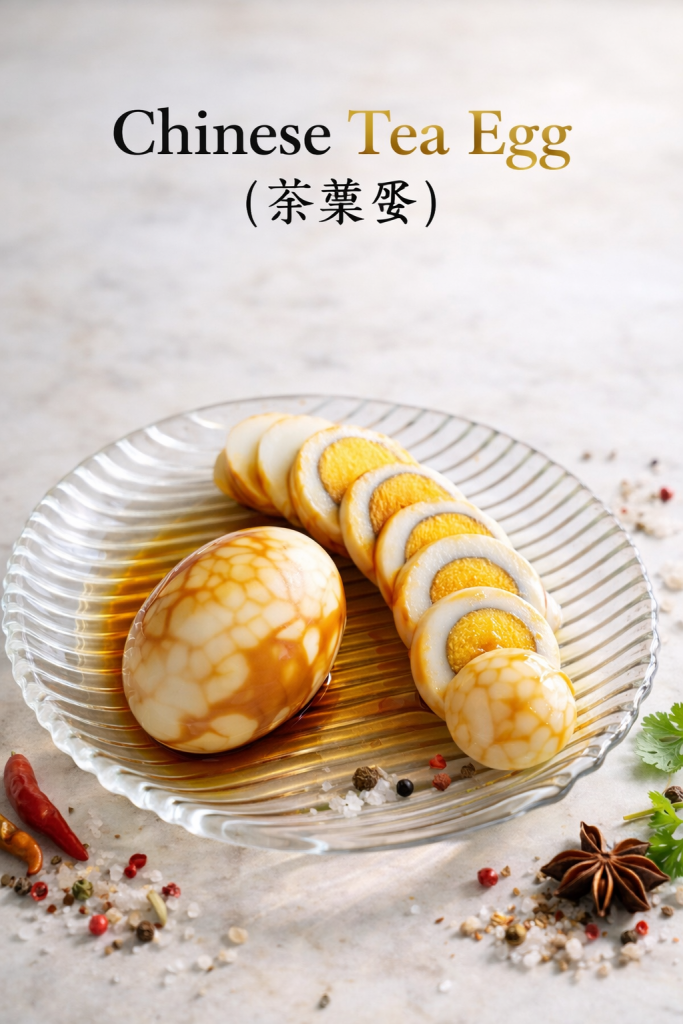
These authentic Chinese tea eggs feature a stunning marble pattern and deep, savory flavor that penetrates all the way to the yolk. Made by gently cracking hard-boiled eggs and steeping them in a fragrant mixture of black tea, soy sauce, star anise, and cinnamon, they're the perfect make-ahead snack, appetizer, or breakfast addition. The secret to that incredible flavor? Patience—letting them steep overnight transforms good eggs into something truly extraordinary.
Ingredients
For the Braising Liquid:
Instructions
-
Bring eggs to room temperature. Remove eggs from refrigerator and let them sit at room temperature for about 1 hour. This prevents cracking when they hit the boiling water .
-
Boil the eggs. Gently place the eggs in a single layer in a pot. Add cool water to cover by about an inch. Bring to a rolling boil over high heat. Once boiling, reduce heat to medium and boil for exactly 7 minutes. This sets the whites while keeping the yolks creamy . Alternatively, you can turn off the heat, cover, and let sit for 10-12 minutes for fully set yolks .
-
Ice bath. While eggs cook, prepare a large bowl of ice water. When the timer goes off, immediately transfer the eggs to the ice bath using a slotted spoon. Let them cool completely for at least 5 minutes . This stops the cooking process and makes them easier to handle.
-
The key step—crackle! Once eggs are cool enough to handle, gently tap each egg all over with the back of a spoon. You want to create a fine web of cracks all over the shell. Do not peel! The cracks should be deep enough to see the membrane but keep the shell intact. Rotate the egg as you tap to ensure even coverage . The more cracks, the more intricate your marble pattern will be.
-
Prepare the braising liquid. In the same pot (now empty), combine water, both soy sauces, tea leaves, star anise, cinnamon stick, bay leaves, Sichuan peppercorns (if using), tangerine peel (if using), sugar, and salt. Bring to a simmer over medium heat, then reduce heat and let it simmer gently for 5 minutes to let the flavors meld .
-
Simmer the eggs. Gently place the cracked eggs back into the simmering liquid. Ensure they are fully submerged—add a little more water if needed. Reduce heat to low, cover, and let it simmer very gently for 1 hour. A rolling boil can cause shells to fall off, so keep the heat low .
-
The magic happens overnight. After simmering, turn off the heat. Leave the eggs in the pot with the liquid. Let them cool to room temperature, then cover the pot and transfer to the refrigerator. Let them steep for at least 8 hours, but ideally 24-48 hours . The longer they steep, the more intense the flavor and marbling! This patience is non-negotiable for authentic results.
-
Serve. Remove eggs from the braising liquid. Carefully peel under cold running water to reveal the beautiful marble pattern. Serve chilled, at room temperature, or slightly warm. If you prefer warm eggs, gently reheat them in their liquid—do not boil .
Nutrition Facts
Servings 12
- Amount Per Serving
- Calories 85kcal
- % Daily Value *
- Total Fat 5g8%
- Saturated Fat 1.5g8%
- Sodium 450mg19%
- Total Carbohydrate 2g1%
- Sugars 1g
- Protein 7g15%
* Percent Daily Values are based on a 2,000 calorie diet. Your daily value may be higher or lower depending on your calorie needs.
Note
- Pro-Tip #1: Room temperature eggs are essential. Cold eggs straight from the fridge can crack when added to boiling water. Let them sit out for an hour before cooking .
- Pro-Tip #2: The tapping pattern is crucial. Use the back of a metal spoon and tap gently but firmly all over. Hold the egg in your palm to absorb some of the impact. You're aiming for a delicate spiderweb of cracks—not chunks of missing shell .
- Pro-Tip #3: Steeping time is non-negotiable. A one-hour simmer gives you lightly flavored eggs. A 24-hour steep gives you deeply infused, richly colored eggs with flavor that reaches the yolk. A 48-hour steep is even better. Trust the process .
- Make-Ahead Instructions: Tea eggs are the ultimate make-ahead food. Prepare them up to 4-5 days before you plan to serve them. Keep them in their braising liquid in the refrigerator, and the flavor will continue to develop .
- Storage Guidelines: Store eggs in their braising liquid in a covered container in the refrigerator for up to 5 days . The flavor will deepen over time. Do not freeze—the texture will become watery and unpleasant.
- Reusing the Brine: The braising liquid can be reused once for a second batch of eggs. Bring it to a rolling boil first, then reduce to a simmer before adding new cracked eggs. The second batch won't be quite as intense, so you may want to add an extra tea bag or a splash more soy sauce .
- Substitutions:
- Tea: Pu-erh gives an earthy, deep flavor; Lapsang Souchong adds a smoky note; Assam or English Breakfast are reliable standards. Avoid green tea, which can become bitter with long cooking .
- Soy sauce: For gluten-free, use tamari or coconut aminos. Dark soy is preferred for color, but you can use all light soy in a pinch.
- Star anise: No substitute—it's essential for that authentic flavor. It's available in most supermarkets or Asian grocery stores.
- Sichuan peppercorns: These add a unique numbing quality but are optional. Omit if unavailable or if you prefer a milder flavor.
- Rock sugar: Regular granulated sugar works perfectly. Rock sugar just gives a slightly cleaner sweetness .
- Tangerine peel: This adds a lovely citrus note but is optional. A strip of fresh orange zest can substitute.
- Troubleshooting:
- "My eggs are barely marbled!" You either didn't crack them enough or didn't steep them long enough. Next time, tap more thoroughly and wait at least 24 hours before peeling.
- "My eggs are too salty!" Reduce the soy sauce next time, or dilute the braising liquid with more water. You can also reduce steeping time.
- "My shells fell off during simmering!" You either cracked too aggressively or boiled too vigorously. Keep the heat at a bare simmer, not a rolling boil .
- "My eggs are rubbery!" You overcooked them. The 7-minute boil (or 10-minute off-heat method) followed by ice bath prevents this. Don't simmer longer than 1 hour.
- "My braising liquid tastes bitter!" Some teas can become bitter with prolonged cooking. Try a different tea, or reduce simmering time for the liquid before adding eggs.
- Ingredient Sourcing:
- Tea: Look for Pu-erh or Lapsang Souchong at specialty tea shops or well-stocked supermarkets. Many Asian grocery stores carry excellent tea for this purpose.
- Star anise and cinnamon: Available in the spice aisle of any supermarket.
- Sichuan peppercorns: Find them at Asian grocery stores or online. They add an authentic touch worth seeking out.
- Dried tangerine peel: Available at Chinese herbal shops or Asian grocery stores. It keeps indefinitely and adds wonderful complexity.