
Intro
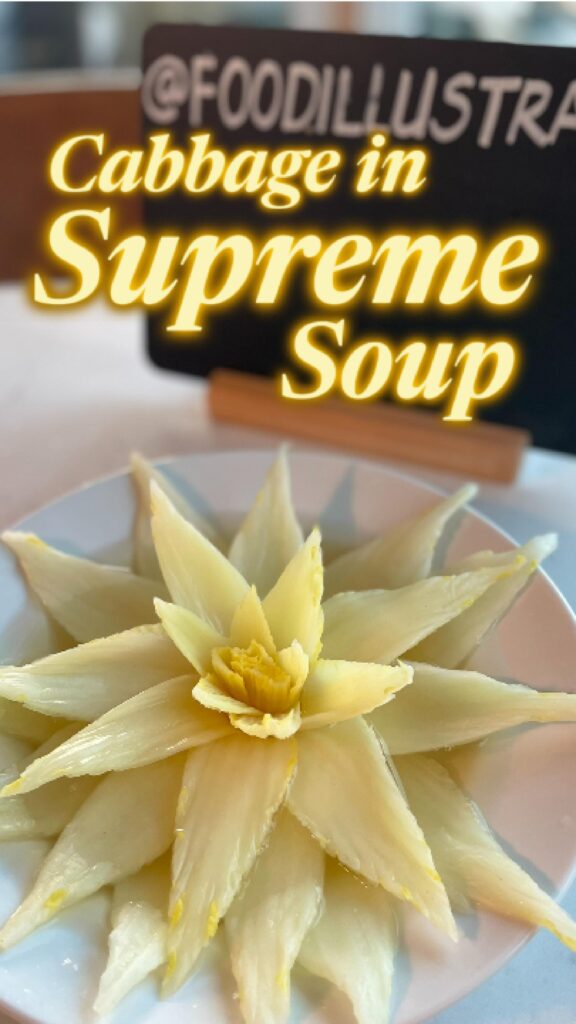
Imagine presenting a bowl of what appears to be nothing more than cabbage in hot water. Now, imagine your guests taking one sip and being utterly speechless. That is the magic of Chinese Consommé, or Kaishui Baicai (开水白菜). This dish is China’s ultimate culinary deception—a national banquet masterpiece where the humblest of ingredients, the cabbage heart, is dressed in a broth so impossibly clear, so profoundly flavorful, that it represents the very pinnacle of Chinese haute cuisine. It requires immense skill, patience, and a philosophy of “gongfu” (功夫)—invisible effort that reveals itself only with the first, unforgettable spoonful. Follow this authentic method to create this legendary soup at home and experience a taste of history.
The History
Kaishui Baicai, which literally translates to “boiled water cabbage,” has a history as rich and layered as its broth. It was created during the Qing Dynasty by a masterful Sichuan chef named Huang Jinglin, who served in the imperial palace . Legend has it that Huang was distressed by the common perception that Sichuan cuisine was only about rough, rustic, and麻辣 (málà, numbingly spicy) flavors . To prove that his native cuisine could also achieve the highest levels of elegance and refinement, he poured his skill into creating a dish that was the very opposite of the fiery food associated with the province. The result was this deceptive masterpiece, which married the intense, umami-packed broths of the imperial kitchen with the simple, pure sweetness of a select cabbage heart .
The dish remained a well-guarded secret of the palace until Huang Jinglin later returned to Sichuan, sharing the technique. Its journey to national and international fame came in 1954 when one of his disciples, the renowned Sichuan chef Luo Guorong, was appointed as the head chef at Beijing Hotel, where he was responsible for state banquets . He brought Kaishui Baicai with him, and it quickly became a signature dish for visiting dignitaries . Premier Zhou Enlai was particularly fond of the dish and featured it at many important state dinners. A famous anecdote tells of a Japanese guest who, upon seeing the seemingly simple bowl of cabbage in clear water, dismissed it. Only after the Premier’s encouragement did she take a sip, and her subsequent astonishment and delight became a legendary tale of the dish’s power to surprise . In 2018, it was officially recognized as one of the Top Ten Classic Dishes of Sichuan, cementing its place in culinary history .
The Science
The name Kaishui Baicai is a deliberate and profound understatement. The “boiled water” is, in reality, perhaps the most labor-intensive and technically demanding soup in the world: a double- or triple-clarified “supreme broth” (高汤, gāotāng). The science behind it is a masterclass in extraction and purification. The initial broth is built by simmering ingredients rich in collagen and glutamates—like chicken, pork, and ham—for hours. This slow, gentle extraction (never a rolling boil) pulls flavor compounds and gelatin into the water, creating a rich, flavorful, but cloudy stock .
The “magic” that turns this cloudy stock crystal clear is a clarification technique known in the West as making a “raft,” and in China as “sǎo tāng” (扫汤), or “cleaning the soup.” Finely minced chicken or lean pork is mixed with egg whites and ice water. This mixture is stirred into the lukewarm, defatted stock. As the stock is slowly heated, the egg white proteins coagulate, forming a solid mat (the raft) on the surface . The key is that the minced meat acts as a powerful filter. As the raft forms and the liquid percolates through it, the microscopic particles of fat and sediment that cloud the stock become physically trapped in the protein matrix . This process, repeated two or three times with fresh meat mixtures, gradually removes all impurities, leaving behind a broth that is visually pristine but has been concentrated with every ounce of savory flavor. The cabbage heart, chosen for its delicate sweetness, is simply blanched to preserve its color and texture, serving as a perfect, neutral canvas for the extraordinary liquid gold .
GOOD PAIRING FOOD AND DRINK
Appetizer: Delicate Shrimp and Chive Dumplings
- Why: The light, translucent wrapper and fresh, subtly sweet filling of shrimp dumplings serve as a gentle prelude. They hint at the seafood and poultry notes in the consommé without overwhelming the palate.
Main Course: Note: This is traditionally served as a palate-cleansing and awe-inspiring course within a multi-course banquet. It would be followed by something like: Peking Duck with Pancakes
- Why: After the sublime clarity of the consommé, the rich, crispy-skinned duck with its sweet bean sauce and fresh vegetables provides a dramatic and satisfying textural and flavor contrast.
Side Dish: Stir-fried Baby Bok Choy with Garlic
- Why: A simple, clean green vegetable echoes the purity of the cabbage in the consommé. The mild garlic adds a savory note that complements the broth without competing.
Dessert: Osmanthus Flower Cake (Guihua Gao)
- Why: This light, subtly sweet, and floral jelly-like cake is a classic Chinese dessert. Its gentle fragrance and delicate texture provide a refreshing and elegant finish that harmonizes with the meal’s theme of understated refinement.
Cocktail: Jasmine Flower-Infused Gin & Tonic
- Why: The floral notes of jasmine and the clean, botanical gin mirror the clarity and purity of the consommé. The slight bitterness and effervescence of the tonic cleanse the palate, preparing it for the next complex layer of flavor.
Non-Alcoholic Drink: Chilled Lychee and Green Tea
- Why: The delicately sweet, aromatic lychee complements the umami of the broth, while the clean, slightly astringent quality of high-quality green tea refreshes the palate and echoes the soup’s “clear” nature.
Description
Discover the legendary Kaishui Baicai, or Chinese Consommé. This national banquet masterpiece features a humble cabbage heart served in a broth so impossibly clear it looks like water, yet so deeply flavorful it represents the pinnacle of Chinese culinary art. A stunning, multi-day project for the dedicated cook.
Ingredients
For the Supreme Broth (高汤):
For the Clarification "Raft" (扫汤)
For the Assembly:
Instructions
PART 1: BUILD THE FOUNDATION (Day 1 - 5 hours)
-
-
Break Down & Blanch: Remove the breasts from the whole chicken and refrigerate. Place the remaining chicken carcass and parts, pork ribs, and ham into a large stockpot. Cover with cold water, bring to a boil, and cook for 5 minutes. This blanching step removes impurities for ultimate clarity. Drain and rinse the meat thoroughly under cold water .
-
The Long Simmer: Return the blanched meats to the clean stockpot with 4 quarts of fresh cold water. Add the smashed ginger, scallion whites, and Shaoxing wine. Bring to a boil, then immediately reduce the heat to the barest simmer—you should see only an occasional bubble. Do not stir or let it boil hard . Skim off any foam that rises to the surface for the first hour. Simmer uncovered for at least 4 hours.
-
First Strain: Carefully strain the broth through a fine-mesh sieve lined with several layers of cheesecloth into a large container. Discard the solids. Let the broth cool completely, then refrigerate overnight. The next day, remove and discard the solid layer of fat from the surface. You now have a rich, flavorful, but still cloudy stock.
-
PART 2: THE CLARIFICATION RITUAL (Day 2 - 2 hours)
-
-
Prepare the Clarification Mixtures: You will perform 2-3 clarification passes. For the first pass, take half of the minced reserved chicken breast and half of the ground chicken. In a bowl, combine them with 1 egg white, half the minced scallion greens, half the minced ginger, ½ cup of ice water, and ½ tsp salt. Mix until it forms a paste. Repeat with the remaining ingredients for the second pass, omitting the salt.
-
First Clarification: Place the cold, defatted broth into a clean pot. Whisk in the first meat mixture (the "raft") thoroughly. Place the pot over medium-low heat. Stir gently and continuously until the mixture reaches about 160°F (70°C), then stop stirring. As the temperature rises, the egg whites will coagulate, forming a solid raft on the surface . Once the raft has formed, gently poke a hole in it to allow the liquid to circulate. Reduce heat to low and simmer very gently for 20-30 minutes. The raft will trap all the impurities.
-
Strain and Repeat: Carefully ladle the now-clear broth from beneath the raft through a fine-mesh sieve lined with fresh cheesecloth. Do not press on the raft, as this will push impurities through. For a crystal-clear consommé, you must repeat this process. Clean the pot and pour the strained broth back in. Repeat Step 5 with the second meat mixture. After the final pass, the broth should be a completely transparent, amber-gold liquid .
-
PART 3: THE BANQUET PRESENTATION (Day 2 - 15 minutes)
-
-
Prepare the "Star": Select the perfect, tight hearts of bok choy or baby Napa cabbage. Trim the base, keeping the leaves attached. You can make a shallow cross-cut in the base to help it cook evenly .
-
Poach to Perfection: Bring a small pot of generously salted water to a rolling boil. Gently place the cabbage hearts in and blanch for 60-90 seconds, just until tender but still vibrantly green . Immediately transfer them to an ice bath to stop the cooking and preserve their color. Drain well and pat dry. Place the cabbage heart artfully in a deep serving bowl.
-
The Grand Reveal: Reheat the clarified consommé gently. Season with salt to taste—it should be a perfect, clean savoriness. Just before serving, bring the consommé to a rolling boil. Pour the piping hot broth over the arranged cabbage. The heat will gently finish warming the cabbage, and it may "bloom" slightly. If using, add a single drop of sesame oil for an extra layer of aroma.
-
Serve Immediately: Present the seemingly simple bowl of "cabbage in water" to your guests and watch their astonishment unfold with their first sip.
-
Nutrition Facts
- Amount Per Serving
- Calories 120kcal
- % Daily Value *
- Total Fat 5g8%
- Total Carbohydrate 2g1%
- Protein 15g30%
* Percent Daily Values are based on a 2,000 calorie diet. Your daily value may be higher or lower depending on your calorie needs.
Note
- Patience is a Virtue: This dish is the definition of gongfu (功夫)—time and skill. Do not rush the simmering or clarification steps. Low and slow is the only way.
- Fat is the Enemy of Clarity: Be absolutely meticulous about removing every trace of fat from the stock after chilling. Any remaining fat will cloud your final consommé.
- Don't Press the Raft: When straining, do not press down on the meat raft. This will force the trapped impurities right back into your beautiful broth.
- Make Ahead: The broth can be made entirely through the clarification process up to 3 days ahead and kept refrigerated. The cabbage should be prepared just before serving.
- Freezing: The clarified consommé freezes beautifully for up to 3 months.