
INTRO
Do you know the only drink that can claim to be the original cocktail? Before mixologists started shaking foamy creations and bartenders reached for blenders, there was just one formula: spirit, sugar, bitters, and water. That formula survives today in a glass of amber liquid over ice, garnished with a twist of citrus. This Old Fashioned recipe delivers that original experience—strong enough to command your attention, balanced enough to sip all evening.
The Old Fashioned isn’t just a cocktail. It’s history in a glass. Every sip connects you to 19th-century American taverns, to pre-Prohibition bartenders, to the very definition of what a cocktail even is. And despite its age—or maybe because of it—this drink has never been more popular. It topped the list of best-selling classic cocktails internationally for the sixth straight year in 2020 . Let’s make one properly.
THE HISTORY
The story begins in 1806. A reader wrote to a New York newspaper called The Balance and Columbian Repository, asking for a definition of this newfangled word “cocktail.” The editor responded on May 13th: a cocktail was a potent concoction of spirits, bitters, water, and sugar . That’s it. No fruit. No fancy liqueurs. Just four ingredients doing exactly what they do best.
For the next several decades, that simple formula ruled American drinking. But by the 1860s, bartenders started getting creative. They added orange curaçao. They experimented with absinthe. They built increasingly complex drinks that impressed customers but strayed far from the original template. Some drinkers pushed back. They wanted their cocktails made the “old-fashioned” way . By the 1880s, bartenders had a name for this request. Ask for an “old-fashioned cocktail,” and you’d get whiskey, sugar, bitters, and water—no modern frills .
The Pendennis Club in Louisville sometimes gets credit for inventing the drink, and Colonel James E. Pepper supposedly brought it to New York’s Waldorf-Astoria. But cocktail historians have debunked this story. Recipes for “Old-Fashioned Whiskey Cocktails” appeared in print years before the Pendennis Club even opened its doors in 1881 .
Prohibition changed everything. When bootleggers produced questionable spirits, drinkers needed ways to mask harsh flavors. Fruit started appearing in Old Fashioneds—muddled orange, a cherry—to cover up what bad whiskey couldn’t hide . After Prohibition ended, some bartenders kept the fruit. Others returned to the purist formula. That divide continues today, and both versions have their passionate defenders.
THE SCIENCE
The Old Fashioned follows a simple geometric truth: every great cocktail balances booze, sweetness, bitterness, and dilution . Get those four elements right, and you can’t fail.
Start with the whiskey. Bourbon brings sweetness and vanilla notes from charred oak. Rye brings spice and a drier finish. Neither is wrong—they just create different drinks. Choose based on what you enjoy.
The sugar does more than add sweetness. It coats your palate, softening the alcohol’s burn and allowing subtle flavors to emerge. A sugar cube dissolves slowly, creating a drink that evolves over time. Simple syrup integrates immediately, giving you consistent flavor from first sip to last. Both work. The difference is control.
Bitters are the magic that transforms sweetened whiskey into a cocktail. Angostura contains dozens of botanicals—gentian root, cassia, clove, and secret spices—that add complexity without overwhelming. Just a few dashes change everything. Without them, you’d have sweet tea (whiskey version). With them, you have an Old Fashioned.
Now consider the ice. Temperature and dilution matter as much as any ingredient. When you stir this drink with large ice cubes, two things happen. First, the temperature drops to around 1.67°C (35°F)—cold enough to tame the alcohol without numbing your palate . Second, controlled dilution releases water molecules that soften the spirit and carry aromatics to your nose. Large cubes melt slowly. Small cubes melt fast and wreck your drink. Choose accordingly .
GOOD PAIRING FOOD AND DRINK
Appetizer: Charcuterie Board with Aged Cheese
Start with a board of cured meats, aged gouda or sharp cheddar, Marcona almonds, and cornichons. The savory saltiness of the meats and the rich nuttiness of the cheese complement the whiskey’s oak and vanilla notes. Add a few figs or olives for contrast—their sweetness echoes the drink’s sugar while their brine cuts through the richness .
Main Course: Espresso-Rubbed Steak
Grill a ribeye or New York strip rubbed with finely ground espresso, brown sugar, and black pepper. The coffee’s bitterness mirrors the cocktail’s Angostura notes, while the char creates a smoky depth that stands up to the whiskey. Let the steak rest, slice thick, and serve alongside your glass .
Side Dish: Spiced Roasted Nuts
Toss pecans and walnuts with melted butter, cayenne, brown sugar, and rosemary. Roast until fragrant and serve warm. The crunch provides textural contrast, the spice echoes the bitters’ warmth, and the sweetness ties everything back to the sugar in your glass .
Dessert: Flourless Chocolate Cake
A dense, rich flourless chocolate cake with a hint of sea salt makes the perfect ending. Dark chocolate’s bitterness harmonizes with the cocktail, while the salt amplifies every flavor. Add a small scoop of vanilla bean ice cream if you’re feeling decadent .
Cocktail: Manhattan
After your Old Fashioned, try its close cousin: rye whiskey, sweet vermouth, and Angostura bitters, stirred and strained into a chilled glass with a cherry. The Manhattan keeps the whiskey and bitters but swaps sugar for fortified wine, creating something drier, more complex, and equally classic.
Non-Alcoholic Drink: Spiced Cherry Shrub
Combine cherry juice, apple cider vinegar, brown sugar, cinnamon, and cloves in a saucepan. Simmer, cool, and strain. Mix with soda water over ice and garnish with an orange twist. You’ll get the same balance of sweet, tart, and spice without the alcohol—a remarkable approximation of the original.
Description
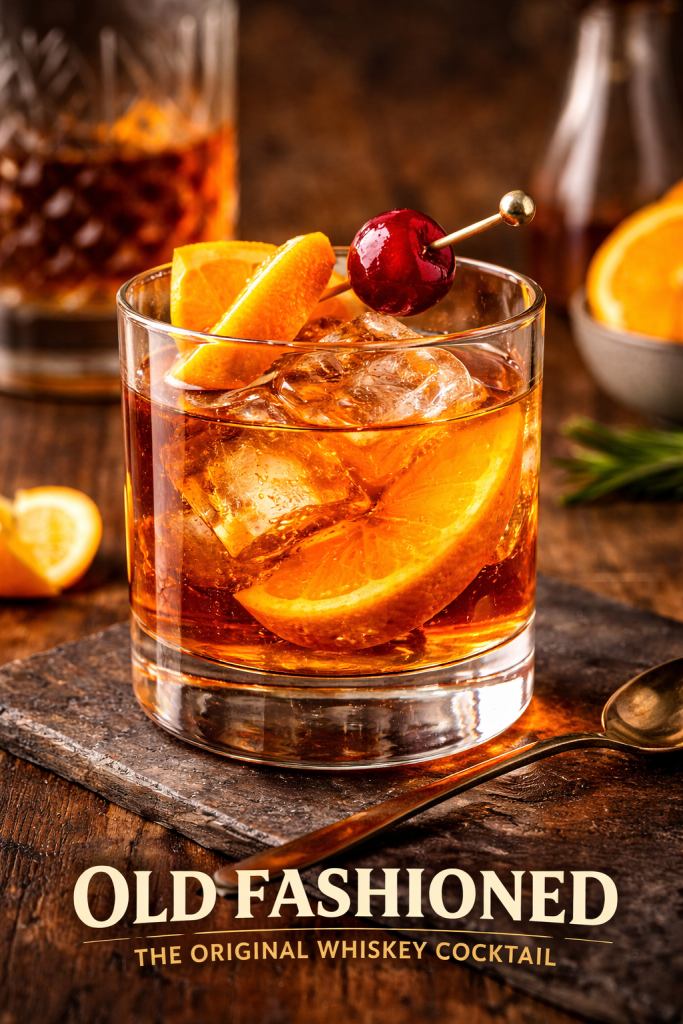
Master the classic Old Fashioned with this foolproof recipe. Bourbon or rye, a sugar cube muddled with bitters, and a single large ice cube create the perfect balance of strong, sweet, and bitter. One sip and you'll understand why this drink has survived for two centuries.
(based on 2 oz 80-proof whiskey)
Instructions
-
Choose Your Glass: Select an old fashioned glass (also called a rocks glass)—short, wide, and heavy. It should feel substantial in your hand.
-
Muddle the Sugar (if using a cube): Place the sugar cube in the glass. Add 2-3 dashes of Angostura bitters directly onto the cube. Add a few dashes of plain water. Use a muddler or the back of a bar spoon to crush and stir until the sugar dissolves completely. This takes about 30 seconds of gentle but firm muddling.
-
If using simple syrup instead of a sugar cube: Simply add 1 teaspoon simple syrup and the bitters to the glass. Skip the water and muddling.
-
Add the Whiskey: Pour 2 oz of your chosen whiskey over the dissolved sugar mixture.
-
Add Ice: Place one large ice cube (or several large cubes) into the glass. Large cubes melt slowly, giving you controlled dilution. Avoid small cubes or crushed ice—they'll water down your drink too fast.
-
Stir Gently: Use a bar spoon to stir for about 30 seconds. The goal is to chill the drink to around 35°F while incorporating just enough water to soften the edges. You'll feel the spoon move more smoothly as the drink chills.
-
Garnish: Express an orange twist or lemon twist over the surface of the drink by holding it between thumb and fingers, skin side down, and giving it a quick bend. Rub the twist around the rim of the glass, then drop it in. Add a cocktail cherry if you're serving the fruit-included style.
-
Serve Immediately: No straws needed. Sip slowly and appreciate how the drink evolves as the ice gradually melts.
Nutrition Facts
Servings 1
- Amount Per Serving
- Calories 154kcal
- % Daily Value *
- Sodium 2mg1%
- Total Carbohydrate 4g2%
* Percent Daily Values are based on a 2,000 calorie diet. Your daily value may be higher or lower depending on your calorie needs.
Note
Whiskey Selection Matters
Choose a whiskey you genuinely enjoy drinking neat. The Old Fashioned doesn't hide flaws—it amplifies them. For a sweeter, vanilla-forward drink, reach for bourbon. For a spicier, drier cocktail, choose rye. Both are correct. Both are delicious.
Sugar Cube vs. Simple Syrup
This decision affects both process and result. Sugar cubes dissolve slowly, giving you more control over sweetness and a slightly different mouthfeel. Simple syrup integrates instantly, creating consistent flavor throughout. Purists often prefer the cube. Home bartenders often prefer the syrup. Neither choice is wrong.
The Ice Situation
If you take only one piece of advice from this entire post, let it be this: use large ice cubes. They melt slower, dilute more gracefully, and keep your drink cold without turning it into sad, watery whiskey at the end. Small cubes are the enemy of a great Old Fashioned .
Citrus Quality
Fresh citrus matters. An orange twist from a fresh orange releases bright, aromatic oils that transform the drinking experience. A lemon twist works beautifully too—try both and see which you prefer. Avoid bottled citrus juice or dried garnishes.
The Fruit Question
Should you include a cherry? Should you muddle orange slices? This debate has raged for over a century. The pre-Prohibition original used no fruit at all—just a lemon twist. The post-Prohibition tradition includes both orange slice and cherry. Some modern craft bartenders split the difference with an expressed citrus twist and a cherry on a pick. I say make it how you like it. Your drink, your rules.