
INTRO
Is there a cocktail more iconic, more debated, or more satisfying than a perfectly chilled Dry Martini? For over a century, this simple blend of gin and vermouth has stood as the ultimate measure of a bartender’s skill and a drinker’s sophistication. This recipe for the perfect Dry Martini cuts through the noise, offering a clear, confident guide to mastering this classic at home. We’ll explore why this version, with its precise ratio and technique, unlocks a symphony of botanical flavors that is far greater than the sum of its parts. It’s not just a drink; it’s a ritual, and we’re here to help you perfect it.
THE HISTORY
The story of the Dry Martini is a fascinating journey from a sweet, complex concoction to the epitome of minimalist elegance. Its origins, like any great classic, are a bit murky, but most cocktail historians trace its lineage back to the late 1800s. A popular theory points to the “Martinez,” a drink served in the California town of the same name to a gold miner heading to San Francisco. That recipe, however, was a far cry from today’s bone-dry version, calling for Old Tom gin (which is sweetened), sweet vermouth, maraschino liqueur, and bitters .
The evolution towards “dryness” began in earnest around the turn of the 20th century. The 1906 Hoffman House Bartenders Guide is credited with publishing what many consider the first recipe for a Dry Martini, reflecting a growing trend for less sweet cocktails . By this time, London dry gin, with its cleaner, more botanical profile, was becoming the preferred base, and it was paired with the newly available French dry vermouths, such as Noilly Prat. The very term “Dry Martini” signified the use of this dry, white vermouth over the original sweet, Italian variety .
The cocktail’s evolution continued through Prohibition and beyond, with the ratio of gin to vermouth growing ever larger. The legend of Winston Churchill’s “Martini”—simply glancing at a bottle of vermouth while pouring his gin—is a humorous extreme of this trend . From President Franklin D. Roosevelt, who was known to enjoy a splash of brine in his cocktails at the White House, to the bars of today slinging hundreds of Martinis a night, this drink’s ability to adapt while retaining its core identity is the very reason we still revere it today .
THE SCIENCE
A Dry Martini is a study in controlled dilution and temperature, a perfect example of how simple physics and chemistry can transform raw ingredients into something transcendent. The technique of stirring, not shaking, is paramount. Agitating the cocktail with ice does two critical things: it chills the liquid and dilutes it with a precise amount of water. Shaking would introduce air bubbles, “bruising” the spirits and leaving the cocktail with a cloudy, unappealing appearance and a slightly sharp taste. Stirring, on the other hand, gently incorporates water, which is essential for “unlocking” the volatile aromatic compounds in the gin and vermouth, allowing their complex botanical notes to express themselves fully .
Temperature is equally crucial. Expert mixologist Grant Collins notes that a gin Martini should ideally be served as close to 0°C (32°F) as possible. Any colder, and the low temperature can actually “trap some of the wonderful botanicals within the gin,” anesthetizing your palate and muting the very flavors you want to taste . This is why pre-chilling your glass and your gin is a game-changer. It allows you to achieve the perfect serving temperature with less stirring, and therefore less unwanted dilution, resulting in a cocktail that is both bracingly cold and perfectly balanced.
Finally, consider the role of water itself. A standard Martini is about 2.5 to 3 ounces of liquid. When you stir with ice, approximately 20-25% of that final volume is melted water. This water doesn’t just chill; it acts as a bridge, softening the alcoholic heat of the spirits and integrating the flavors of the gin and vermouth into a cohesive, silky whole . This is why a bottled, pre-diluted Martini can be so exceptional—the water is precisely measured, allowing for perfect integration and an incredibly velvety mouthfeel .
GOOD PAIRING FOOD AND DRINK
The Dry Martini is a remarkably versatile companion to food, its clean, sharp profile acting as a perfect palate cleanser and contrast to a variety of flavors.
- One Appetizer: Oysters on the Half Shell. The briny, fresh salinity of a raw oyster is a match made in heaven with a Dry Martini . The cocktail’s botanical notes, especially if made with gin, complement the oyster’s minerality, while its high acidity and chill cut through the richness. A squeeze of lemon and a touch of mignonette on the oyster echo the citrus oils expressed over the drink itself, creating a harmonious and luxurious start to a meal.
- One Main Course: Seared Scallops with Beurre Blanc. For a truly elegant pairing, the delicate sweetness of perfectly seared scallops is a stunning contrast to the Martini’s herbal and juniper-forward punch. A rich, buttery sauce mirrors the cocktail’s silky mouthfeel, while the scallops provide a neutral, sweet canvas that lets the drink’s complexity shine.
- One Side Dish: Herbed Pommes Anna. This classic French side dish of thinly sliced potatoes baked in a mountain of butter until crispy and tender is rich and decadent. The Dry Martini’s crispness and subtle botanicals (tarragon, chives, or parsley in the dish) would slice through the richness, making each bite and sip as compelling as the first.
- One Dessert: Lemon Olive Oil Cake. To echo the savory notes of the cocktail’s olive garnish while providing a sweet conclusion, a simple, moist olive oil cake infused with lemon is ideal. The fruitiness of the olive oil and the bright citrus connect directly back to the Martini’s character, while the cake’s modest sweetness won’t overwhelm the palate.
- One Cocktail and One Non-Alcoholic Drink:
- Cocktail: A Classic Negroni. If you’re savoring a Dry Martini as an aperitif, following it with a Negroni is a logical and delightful progression. Both are gin-forward classics, but the Negroni’s bitter Campari and sweet vermouth offer a deeper, more complex counterpoint to the Martini’s crisp restraint.
- Non-Alcoholic Drink: Fever-Tree Refreshingly Light Mediterranean Tonic with a Lemon Twist. This sophisticated non-alcoholic option mirrors the experience of a Martini. The tonic’s slight bitterness and botanical complexity are elevated by a twist of lemon, providing a similar sense of aromatic refreshment without the alcohol.
Description
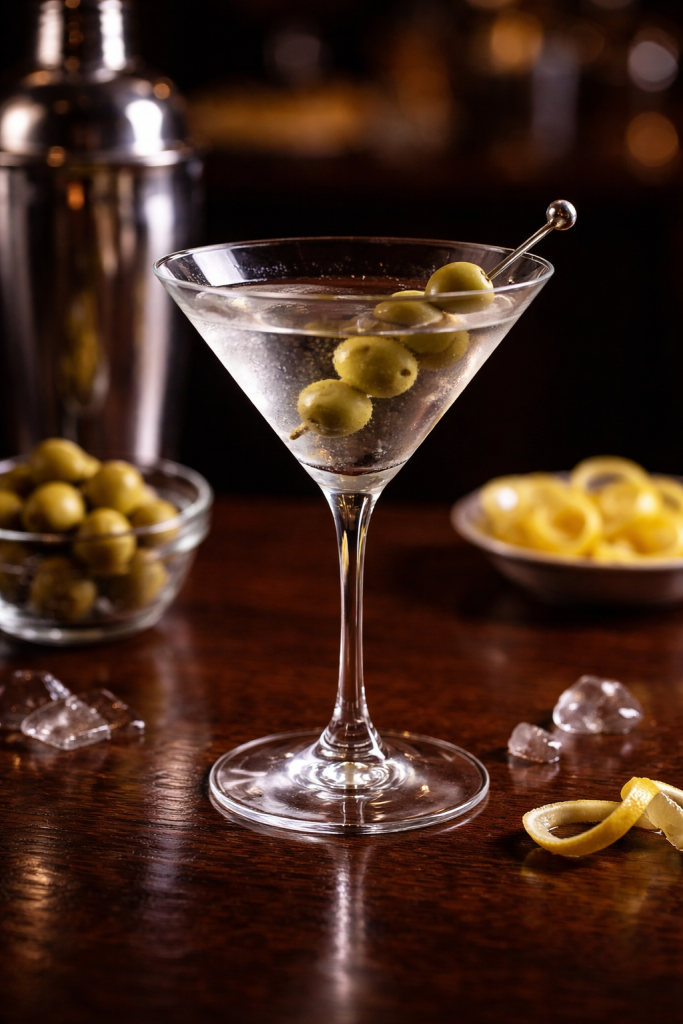
This is the only Dry Martini recipe you'll ever need. We break down the science of dilution and temperature to help you create a perfectly balanced, silky-smooth cocktail at home. Garnish with a lemon twist or olive and impress your guests.
Ingredients
Instructions
-
Chill Your Glass: Place your Martini glass or coupe in the freezer for at least 15-20 minutes before you begin. A properly chilled glass is key to keeping the cocktail cold without over-diluting it.
-
Chill Your Spirits (Optional but Recommended): For ultimate control, place your bottle of gin in the freezer as well. Very cold gin requires less stirring to reach the ideal temperature.
-
Combine in Mixing Glass: Fill a mixing glass (or a pint glass) with a generous amount of ice. The ice should be fresh, hard, and cold. Pour the gin, dry vermouth, and orange bitters (if using) over the ice.
-
Stir, Don't Shake: Stir the mixture continuously with a long-handled bar spoon for 30-45 seconds. The goal is to achieve the perfect chill and dilution. You'll know it's ready when the spoon feels cold in your hand and a thin layer of frost forms on the outside of the mixing glass. Remember, as one expert notes, "Martini overall is dilution. How you control the liquid being at proper temperature and how you control the dilution" is everything .
-
Strain and Garnish: Remove the chilled glass from the freezer. Place a Hawthorne strainer over the mixing glass and strain the cocktail into the prepared glass.
-
Express the Garnish: If using a lemon twist, hold the peel, colored side down, over the glass and give it a firm twist to spray the essential oils onto the surface of the drink. Gently rub the twist around the rim of the glass and then drop it in or discard it. If using olives, simply skewer them on a pick and place them in the glass.
-
Serve Immediately: Your perfect Dry Martini is ready to be enjoyed.
Nutrition Facts
- Amount Per Serving
- Calories 160kcal
- % Daily Value *
- Sodium 2mg1%
- Total Carbohydrate 0.1g1%
* Percent Daily Values are based on a 2,000 calorie diet. Your daily value may be higher or lower depending on your calorie needs.
Note
- Pro Tip for Success: Stir, don't shake! As James Bond popularized the shaken Martini, it's worth noting that for a classic gin Martini, stirring is the superior method. Shaking creates micro-air bubbles that can make the drink appear cloudy and taste slightly "bruised" or sharp. Stirring yields a silky, crystal-clear cocktail.
- The Ratio is a Personal Journey: The classic IBA (International Bartenders Association) recipe calls for a 6:1 ratio of gin to vermouth . This recipe starts with a very dry 5:1 ratio. Feel free to experiment. A "50/50 Martini" (equal parts gin and vermouth) offers a wonderfully complex and lower-alcohol version. A "Montgomery" or "Hemingway" Martini is said to have a ratio of 15:1, a reference to the British general who insisted on engaging the enemy with 15-to-1 odds .
- Vermouth is a Wine, Treat it Like One: Dry vermouth is a fortified wine. Once opened, it will oxidize and lose its freshness. Store it in the refrigerator and try to use it within 4-6 weeks for the best flavor.
- Garnish Decoder:
- Lemon Twist: Highlights the citrus notes in the gin. The essential oils add a bright, aromatic lift.
- Olive: Adds a touch of salinity that complements the gin's botanicals and makes the drink taste slightly savory and "dirty."
- Cocktail Onion: If you choose an onion, you are technically drinking a Gibson, a close and delicious relative of the Martini.