
Learn how to make Apple Tarte Tatin, the classic French upside-down tart. Caramelized apples, flaky puff pastry, and a rich buttery sauce—surprisingly simple and utterly impressive.
INTRO
Have you ever bitten into a dessert that felt like pure magic? The kind where caramelized apples surrender under flaky pastry, where butter and sugar have transformed into something golden and transcendent? That’s Apple Tarte Tatin—and here’s the beautiful secret: it’s actually one of the simplest impressive desserts you’ll ever make.
I still remember the first time I flipped a Tarte Tatin. My heart raced as I placed the serving plate over the skillet, said a little prayer, and flipped. When I lifted the pan to reveal perfectly arranged apples glistening in amber caramel, I actually laughed out loud. It looked like something from a French patisserie window. And I had made it. In my kitchen. On a Tuesday.
This Apple Tarte Tatin recipe strips away any intimidation. With just a handful of ingredients—apples, sugar, butter, and puff pastry—you’ll create a dessert that tastes like you spent hours in the kitchen. The secret lies in the caramel: watching it transform from granular sugar to liquid gold is pure kitchen alchemy. And that moment of flipping? Pure theater.
In this post, I’ll walk you through every step, from choosing the right apples to mastering the flip. Trust me—once you make this, you’ll never buy dessert for a dinner party again.
THE HISTORY: A Happy Accident That Became a Legend
Every great dessert has an origin story, but few are as charmingly accidental as the Apple Tarte Tatin. The year was the 1880s, and the place was the Hôtel Tatin in Lamotte-Beuvron, a small town south of Paris. The hotel was run by two sisters, Stéphanie and Caroline Tatin, who had built a reputation for warm hospitality and hearty cooking.
One afternoon during the busy hunting season, the story goes, Stéphanie was preparing an apple pie for hungry guests. Overwhelmed and distracted, she left a pan of apples cooking in butter and sugar for too long. The apples began to caramelize, verging on burning. In a panic, she tried to salvage the situation by placing pastry dough directly over the apples and shoving the whole pan into the oven.
After baking, she courageously inverted the tart onto a platter—and discovered something extraordinary. The accident had created a dessert where the apples were gloriously caramelized on top, the pastry was crisp and golden underneath, and the whole thing glistened like edible amber. Her guests were delighted. A legend was born.
The Tatin sisters never intended to create a culinary masterpiece. They simply ran a country hotel and fed hungry travelers. But word of this accidental dessert spread. By the early 20th century, it had been adopted by Parisian restaurants, including the famed Maxim’s, where it became a signature dish. The recipe was published, debated, and refined—but always credited to those two sisters in the Loire Valley.
Today, Apple Tarte Tatin stands as a beautiful testament to the fact that the best discoveries often come from mistakes. It’s been made with pears, peaches, even tomatoes for savory versions. But the classic apple Tarte Tatin remains the standard—a dessert that transforms humble ingredients into something worthy of celebration. Every time I flip one, I think of Stéphanie Tatin, that harried cook in a country hotel, who turned a near-disaster into one of France’s most beloved desserts.
THE SCIENCE: What Makes Tarte Tatin So Magical
Behind that gorgeous, glistening Apple Tarte Tatin lies some fascinating kitchen science. Understanding what’s happening chemically transforms you from a recipe follower into a true dessert artist.
Let’s start with the caramel. When you heat sugar with water, you’re initiating a complex series of chemical reactions. As the temperature rises, water evaporates and the sugar molecules begin to break down and re-form into hundreds of new compounds. Around 320°F (160°C), the sugar reaches the caramelization stage. Those light amber colors you’re looking for? They’re the visual signal that the sugar has transformed into something far more complex than sweetness—it’s now carrying notes of bitterness, toastiness, and deep, almost savory richness.
The addition of butter does two things. First, it stops the caramelization process by cooling the mixture slightly, preventing it from burning. Second, the milk solids in butter contribute their own flavor compounds during browning, adding a nutty, almost hazelnut quality that complements the caramel beautifully. When you stir the butter in and it bubbles up dramatically, that’s the water in the butter meeting the hot sugar—a moment that requires both caution and appreciation.
Now, about those apples. The choice of firm baking apples like Granny Smith or Honeycrisp isn’t arbitrary. These varieties contain more pectin, a structural polysaccharide that holds the apple cells together during cooking. Softer apples would break down completely, turning into applesauce. Firm apples soften just enough to become tender while maintaining their shape, creating those beautiful caramel-coated quarters that hold their form when flipped.
The pectin also interacts with the sugar and acid in the apples, contributing to the final texture. As the apples cook in the caramel, they release some of their own juices. Those juices combine with the caramel to create the sauce that pools around the finished tart—part apple, part sugar, part butter, entirely delicious.
The Maillard reaction also plays a role in the pastry browning, creating those deep golden hues and nutty flavors. The puff pastry deserves its own moment of scientific appreciation. When you bake it directly over the cooking apples, something clever happens. The steam from the hot apples hits the cold pastry, creating pockets of vapor that push the layers apart. That’s what gives puff pastry its characteristic flakiness. By the time the pastry is golden brown, it’s also absorbed some of the caramel’s flavor from below, creating a beautiful transition from crisp crust to tender fruit.
Finally, the rest period before flipping is critical. As the tart cools, the caramel sets slightly. If you flipped it immediately, the caramel would run everywhere like lava. Waiting 15-30 minutes allows it to thicken to that perfect coating consistency—thick enough to cling to the apples, fluid enough to create that gorgeous pool around the tart. It’s chemistry and patience working together.
GOOD PAIRING FOOD AND DRINK
One Appetizer: Cheese Board with Aged Comté and Walnuts
Start your meal with a simple French cheese board. Aged Comté, with its nutty, crystalline texture, prepares the palate for the caramelized apples to come. Add some crusty bread and a handful of toasted walnuts—their earthiness complements both the cheese and the dessert beautifully.
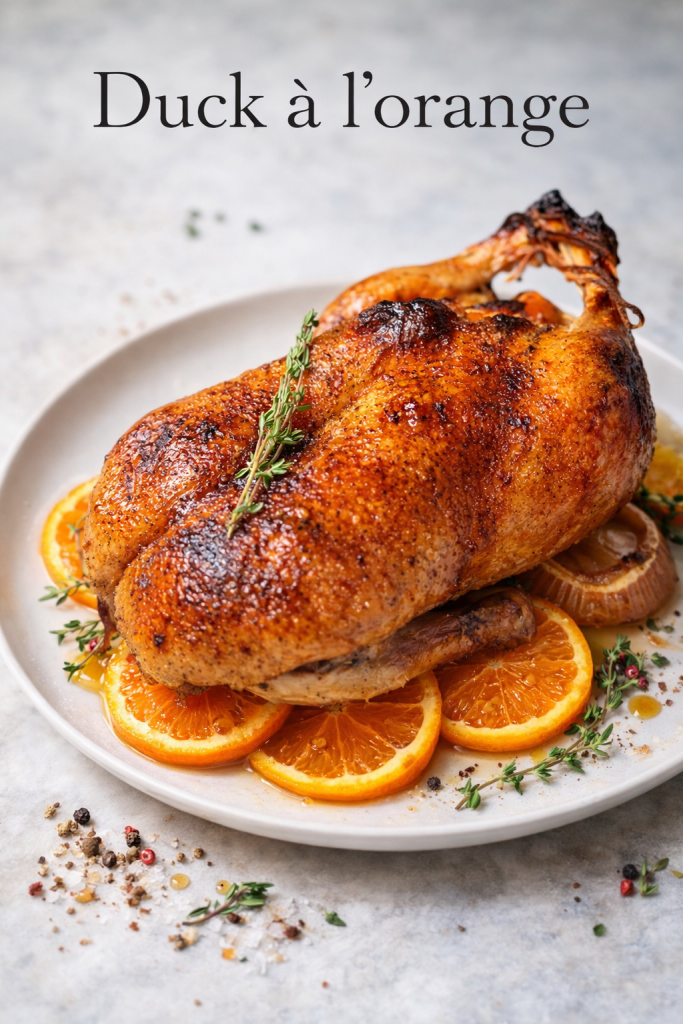
One Main Course: Roasted Duck à l’Orange
This classic French duck dish shares the Apple Tarte Tatin’s love affair with caramelized fruit. The orange sauce echoes the apple’s sweetness while offering a bright, citrusy contrast. Serve them together for a French feast that will transport your guests to a Parisian bistro. Check out our Roasted Duck à l’Orange recipe here.
One Side Dish: Frisée aux Lardons
A bitter green salad with crispy bacon lardons and a poached egg provides the perfect savory counterpoint to the sweet tart. The bitterness cuts through richness, while the bacon’s smokiness echoes the caramel’s depth. It’s a classic French bistro combination for good reason.
One Dessert: This is the dessert! But if you’re building a multi-course sweet finale, serve it alongside a small pot of crème fraîche for dolloping, and maybe some delicate madeleines for nibbling.
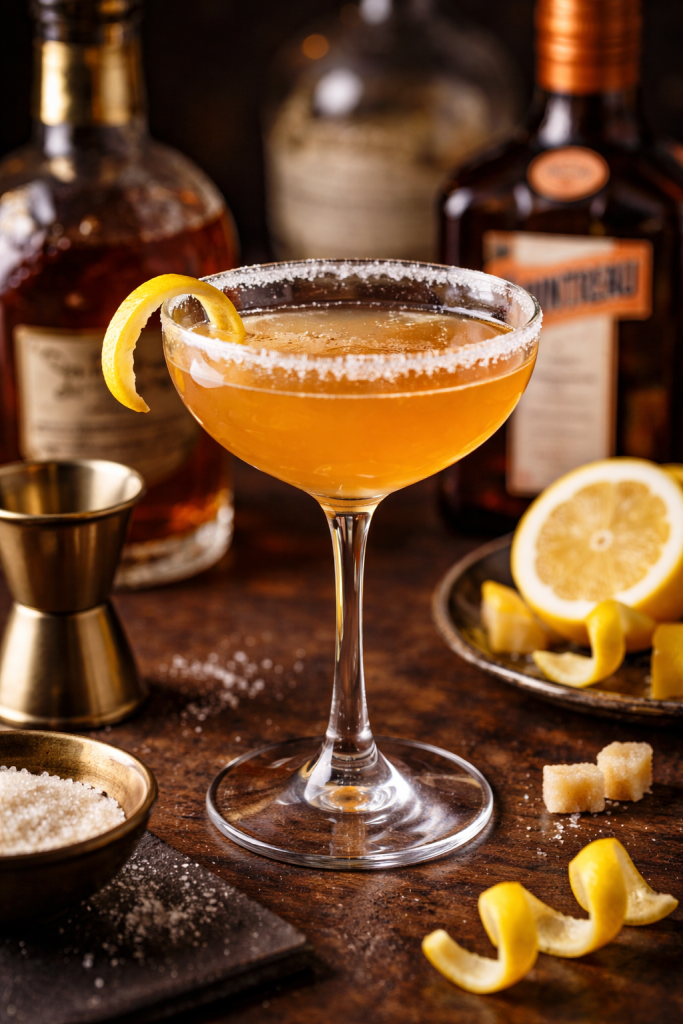
One Cocktail: Calvados Sidecar
Replace the cognac in a classic Sidecar with Calvados, the apple brandy from Normandy. The apple notes mirror the tart’s flavors, while the lemon and orange liqueur provide brightness. It’s like the Apple Tarte Tatin in liquid form. Try our Classic Sidecar recipe as a base.
One Non-Alcoholic Drink: Sparkling Apple Cider with Thyme
Heat fresh apple cider with a cinnamon stick and a few sprigs of thyme, then chill and serve over ice with a splash of sparkling water. The apple flavor echoes the tart, while the herbs add sophistication. Garnish with a thin apple slice and a thyme sprig.
Description
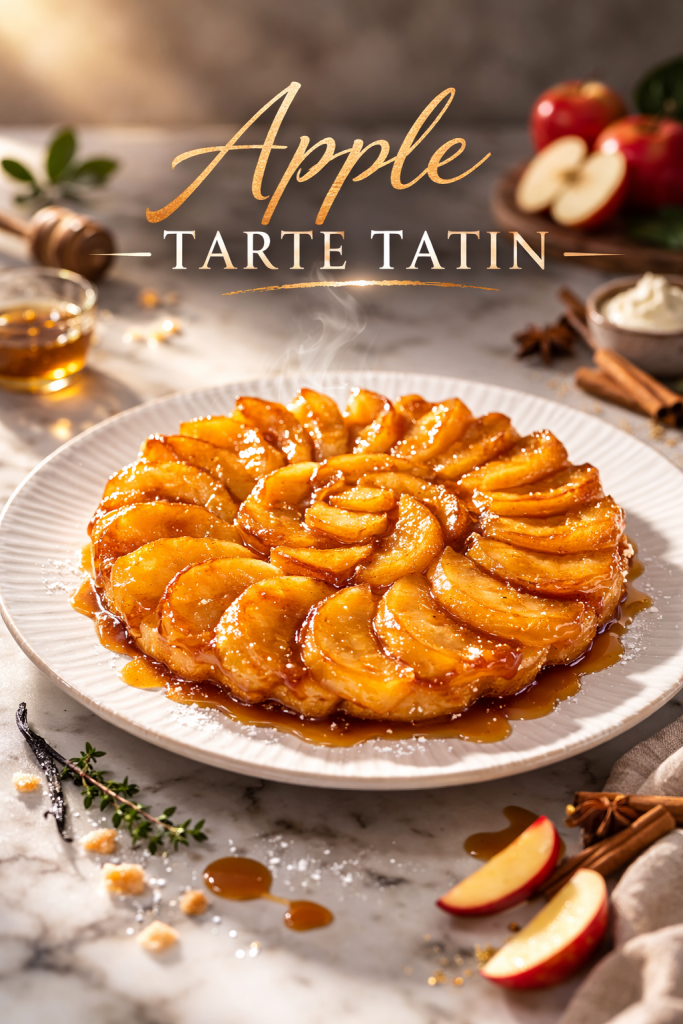
This Apple Tarte Tatin transforms humble apples into a showstopping French dessert. Caramelized to golden perfection and baked under flaky puff pastry, it's elegant enough for company but simple enough for any night of the week.
Ingredients
Instructions
-
Preheat your oven. Set the oven to 400°F (200°C) with a rack in the center position. Place a rimmed baking sheet on the rack below to catch any potential drips.
-
Prepare the apples. Peel the apples, then quarter them and remove the cores. Set aside. Visual cue: You want neat, uniform quarters that will arrange beautifully in the pan.
-
Start the caramel. In a 10-inch oven-proof skillet (cast iron is ideal), sprinkle the sugar evenly over the bottom. Drizzle the water over the sugar. Place the skillet over medium heat and cook, stirring occasionally with a heatproof spatula, until the sugar dissolves and the mixture begins to bubble.
-
Watch carefully: After about 5-7 minutes, the mixture will turn light amber. This is your signal.
-
Add the butter. Stir in the butter pieces carefully—the mixture will bubble up vigorously. Continue stirring until the butter melts completely and incorporates into the caramel. The caramel will be smooth and glossy.
-
Cook the apples. Add the apple quarters to the skillet. Cook over medium heat, stirring the apples gently every few minutes, until the caramel deepens to a rich amber color, about 15 minutes. The apples will soften slightly and release some of their juices, combining with the caramel to create a beautiful sauce.
-
Don't worry if the apples aren't fully cooked—they'll finish in the oven.
-
Arrange the apples. Remove the skillet from the heat. Using a spatula or tongs, arrange the apple quarters in concentric circles, curved side down, packing them as tightly as possible. The apples will shrink during baking, so crowd them in. Pour any remaining caramel from the pan over and around the apples.
-
Prepare the pastry. On a lightly floured surface, roll the puff pastry sheet slightly to smooth out the folds. Cut it into an 11-inch circle—you can use the skillet as a guide by tracing around it with a knife. Place the pastry circle over the apples, tucking the edges down around the apples with a spatula or your fingers.
-
Bake. Place the skillet on the rimmed baking sheet (to catch any overflow) and transfer to the oven. Bake for 35-40 minutes, until the puff pastry is puffed and deep golden brown. Visual cue: The pastry should look fully baked and slightly crisp to the touch.
-
Cool briefly. Remove the skillet from the oven and place it on a wire rack. Let it cool for 15 minutes (up to 30 minutes if using cast iron, which retains heat longer). This rest period allows the caramel to set slightly, making the flip more successful.
-
The moment of truth—flip the tart. Place a large rimmed serving platter (slightly larger than the skillet) upside down over the skillet. Wearing oven mitts, carefully and confidently invert the skillet and platter together. Lift the skillet slowly. If any apples stick, gently nudge them back into place with a spatula—work quickly while the tart is still warm.
-
Serve. Let the tart cool slightly, then serve warm or at room temperature. A dollop of crème fraîche or a scoop of vanilla ice cream is traditional and welcome.
Nutrition Facts
Servings 6
- Amount Per Serving
- Calories 441kcal
- % Daily Value *
- Total Fat 20g31%
- Saturated Fat 10g50%
- Cholesterol 30mg10%
- Sodium 180mg8%
- Potassium 180mg6%
- Total Carbohydrate 65g22%
- Dietary Fiber 4g16%
- Sugars 45g
- Protein 3g6%
- Vitamin C 8 mg
* Percent Daily Values are based on a 2,000 calorie diet. Your daily value may be higher or lower depending on your calorie needs.
Note
Pro Tips for Success:
- Choose the right apples. Firm, tart apples like Granny Smith or Honeycrisp are essential. They hold their shape during cooking and their acidity balances the sweet caramel. Avoid soft varieties like McIntosh or Red Delicious—they'll turn to mush.
- Don't cut the apples too small. Quarters are ideal. Smaller pieces break down too much during the long cooking time. You want recognizable apple pieces that still have some structure.
- Pack those apples in tightly. Apples shrink significantly as they cook. If you leave gaps, you'll have empty spaces in your finished tart. Really crowd them in—you'll be glad you did.
- Watch the caramel like a hawk. Caramel can go from perfect to burnt in seconds. The first time you make this, stay close to the stove. Look for a deep amber color—think the color of a penny.
- Thaw your puff pastry completely. Pastry that's still partially frozen will crack and tear when you try to roll it. Leave it in the refrigerator overnight or on the counter for about 30 minutes.
- Run a knife around the edge before flipping. This simple step releases any stuck caramel and makes the flip much cleaner. Do it just before you place the platter on top.
- Work quickly after flipping. If apples shift during the flip, you have a small window while the tart is still warm to nudge them back into place. Once the tart cools completely, the caramel sets and you're stuck with whatever happened.
Make-Ahead Instructions:
- You can prepare the apples and caramel through step 5 up to 2 hours in advance. Let everything cool in the skillet, then arrange the apples and top with pastry just before baking.
- The fully baked and cooled tart can be kept at room temperature for up to 8 hours. Reheat gently in a 350°F oven for 10 minutes before serving.
Storage Guidelines:
- Room temperature: Cover loosely and store for up to 1 day. The pastry will soften slightly but will still be delicious.
- Refrigerator: Store covered for up to 3 days. Bring to room temperature or reheat gently before serving.
- Freezer: Not recommended—the texture of both apples and pastry suffers upon thawing.
Substitutions:
- No Granny Smith apples? Use Honeycrisp, Braeburn, Pink Lady, or any firm, tart baking apple.
- Salted butter substitution: Use unsalted butter plus ¼ teaspoon flaky salt added with the butter.
- Gluten-free option: Use a gluten-free puff pastry. The technique remains the same, though baking time may vary slightly.
- Vegan version: Use vegan butter and a vegan puff pastry. The caramel will still be delicious.
- Different fruits: This technique works beautifully with pears, peaches, nectarines, plums, or even quince. Adjust cooking time slightly based on fruit firmness.
Troubleshooting:
- Caramel crystallized and turned grainy? A grain of undissolved sugar can trigger crystallization. Next time, avoid stirring once the sugar has dissolved, and brush down the sides of the pan with a wet pastry brush to prevent crystals from forming.
- Apples stuck to the pan after flipping? Let the tart cool longer next time, and run a knife around the edge more thoroughly. If it happens anyway, gently warm the skillet to loosen the caramel, then try again.
- Pastry under-baked in spots? Make sure your oven is fully preheated and that you've placed the skillet on a baking sheet to ensure even bottom heat.
- Tart slid off the platter? Use a rimmed platter! The rim catches any runaway caramel or apples.