
INTRO
What happens when you combine the fiery spectacle of the “Hot Ones” challenge with the technique-driven philosophy of Gordon Ramsay? You get the most insanely delicious, ridiculously crispy chicken wings you’ve ever pulled from your own oven.
I’ll be honest—I’ve always been skeptical of oven-baked wings. They promised crispiness but delivered flabby skin and dry meat. They claimed to rival fried wings but fell short every single time. Then I discovered this method, and everything changed. The secret isn’t complicated marinades or special equipment. It’s a simple two-step process that starts on the stovetop and finishes in the oven, yielding wings with skin so shatteringly crisp you’ll swear they emerged from a deep fryer.
These Gordon Ramsay Hot Wings capture everything we love about the “Hot Ones” experience—the escalating heat, the buttery richness, the addictive quality that makes you reach for just one more—without any of the intimidation. They’re approachable enough for a casual game day spread but impressive enough to serve at a party where you want to show off. And because they’re oven-baked, you get all the flavor with none of the mess or guilt of deep-frying.
THE HISTORY
To understand these wings, we need to trace two distinct threads: the evolution of Buffalo wings and the cultural phenomenon of “Hot Ones.”
The chicken wing itself was once considered a throwaway cut—too bony, too fatty, destined for the stockpot at best. That changed in 1964 at the Anchor Bar in Buffalo, New York, when co-owner Teressa Bellissimo needed a late-night snack for her son and his friends. She took wings that were meant for stock, deep-fried them, and tossed them in a mixture of melted butter and hot sauce. The Buffalo wing was born, and American snacking would never be the same.
Fast forward to 2015, when a little web series called “Hot Ones” debuted on YouTube. The concept was deceptively simple: host Sean Evans interviews celebrities while they eat increasingly spicy chicken wings. What made it work wasn’t just the heat—it was the vulnerability. Watching someone you admire sweat, cry, and struggle through progressively hotter sauces while answering thoughtful questions created a new kind of entertainment.
The show became a phenomenon, and with it came a renewed fascination with hot wings. Viewers wanted to experience that same journey at home—the burn, the endorphin rush, the triumphant finish. But they also wanted wings worthy of the challenge: crispy, meaty, and capable of carrying complex sauces.
Enter Gordon Ramsay. While Ramsay didn’t invent a specific wing recipe, his cooking philosophy—high heat, proper technique, respect for ingredients—perfectly aligns with what great wings demand. His insistence on starting proteins in a screaming hot pan, his understanding of how butter transforms sauces, his refusal to compromise on texture—these principles form the backbone of this recipe.
Time Magazine – Sean Evans TIME100 Creators 2025 Profile
https://time.com/collections/time100-creators-2025/7299171/sean-evans/
THE SCIENCE
Let’s get into what’s actually happening when you create these wings, because understanding the science transforms you from a recipe-follower into a wing master who can troubleshoot and adapt.
The Drying Imperative
Moisture is the enemy of crispiness. Chicken skin is about 70% water, and that water must evaporate before browning can occur. When you pat the wings dry, you’re removing surface moisture that would otherwise turn to steam, creating a barrier between the skin and the hot pan. The dry rub—garlic powder and smoked paprika—does double duty. It adds flavor while absorbing any remaining surface moisture. Some wing obsessives even leave seasoned wings uncovered in the refrigerator overnight, allowing the skin to dry further. For this recipe, thorough patting is non-negotiable.
The Maillard Reaction in Action
When those wings hit the hot pan, something magical happens. The Maillard reaction—the chemical process between amino acids and reducing sugars—creates hundreds of new flavor compounds. That browning isn’t just color; it’s complexity. The initial sear on the stovetop jumpstarts this reaction, creating a foundation of flavor that oven heat alone cannot replicate. By not moving the wings for those first few minutes, you allow the crust to form fully. Moving them too early tears that developing crust and releases moisture.
The Butter Paradox
Butter in the pan serves multiple purposes. Its milk solids brown and add nutty richness. Its fat conducts heat evenly. But here’s the key: butter contains about 16-18% water. As that water evaporates, it creates micro-steaming that actually helps render the subcutaneous fat under the skin. The foaming action you see is that water escaping, leaving pure butterfat behind. This is why we add butter at the beginning and again at the end—the first batch helps render and brown, the second batch creates the glossy, emulsified sauce.
The Oven Finish
Moving the pan to the oven accomplishes what stovetop heat cannot: gentle, even rendering. The high initial heat crisps the exterior, but the oven’s ambient heat slowly melts the fat beneath the skin without burning the surface. This two-stage process ensures skin that’s crispy all over, not just on the contact side. The target internal temperature of 165°F ensures the meat is cooked through but still juicy—chicken wings can handle a bit more heat than breast meat, but they’ll dry out if pushed much beyond 170°F.
The Sauce Emulsion
When you toss the hot wings with pan drippings, hot sauce, and butter, you’re creating a temporary emulsion. The butter fat, suspended liquid from the hot sauce, and flavorful pan juices combine into a coating that clings to every nook and cranny of the crispy skin. The vigorous tossing isn’t just for distribution—it’s mechanically forcing the fat and liquid to combine. The result is wings that are coated, not soggy.
IMMPress Magazine – The Science of Culinary Arts
https://www.immpressmagazine.com/the-science-of-culinary-arts/
GOOD PAIRING FOOD AND DRINK
One Appetizer: Blue Cheese Dip with Crudités
Before the wings arrive, set out a bowl of homemade blue cheese dip surrounded by crisp celery sticks, carrot batons, and cucumber slices. The cool, tangy, creamy dip provides the classic Buffalo wing accompaniment while offering relief from the heat to come. The vegetables also serve as palate cleansers between wing varieties. Making the dip from scratch—crumbled blue cheese stirred into sour cream with a splash of buttermilk and a pinch of garlic powder—elevates it far above bottled versions.
One Main Course: These wings are the star of any spread and don’t need a main course companion. If you’re building a full meal around them, consider them the centerpiece with multiple sides.
One Side Dish: Loaded Potato Wedges
Thick-cut potato wedges, tossed in olive oil and seasoned with the same smoked paprika and garlic powder, roasted until crispy, then finished with melted cheddar, crispy bacon bits, and a drizzle of ranch. The potatoes provide hearty substance, the cheese and bacon echo the wings’ indulgent quality, and the cooling ranch mirrors the dip. They’re also sturdy enough to soak up any extra wing sauce on the plate.
One Dessert: Honey-Lime Fruit Salad with Mint
After all that heat and richness, something bright and refreshing is essential. Toss fresh seasonal fruit—melon, berries, citrus segments, mango—with a light dressing of honey, fresh lime juice, and shredded mint. The natural sugars cool the palate, the acid cuts through lingering fat, and the mint provides a clean finish. It’s light enough to feel like a reset but satisfying enough to end the meal.
One Cocktail: The Spicy Mango Margarita
Muddle fresh jalapeño slices with mango chunks, then shake with tequila, fresh lime juice, and a touch of agave. Strain over ice and garnish with a chili-salt rim. The drink mirrors the wings’ heat while adding tropical sweetness that complements the smoky paprika. The citrus cuts through the butter richness, and the tequila’s agave notes play nicely with the honey in the dessert.
One Non-Alcoholic Drink: Cucumber-Mint Cooler
Muddle cucumber slices and fresh mint, add fresh lime juice and a touch of honey, then top with sparkling water and serve over ice. The cooling cucumber and mint provide immediate relief from spice, while the bubbles refresh the palate. It’s hydrating, sophisticated, and far more interesting than soda. For extra heat seekers, a few thin slices of jalapeño can be added.

Description
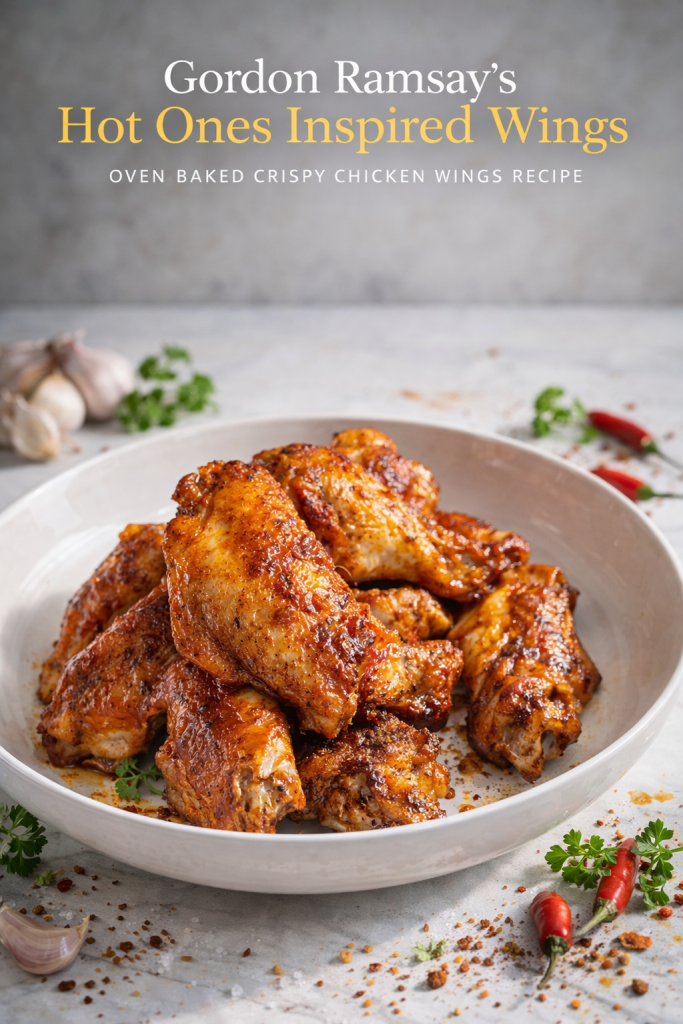
These Gordon Ramsay Hot Wings deliver the perfect balance of shatteringly crispy skin and juicy meat, tossed in a fiery butter sauce inspired by the "Hot Ones" experience. A simple stovetop-to-oven method creates wings so good you'll never deep-fry again.
Ingredients
For the Wings:
For the Hot Sauce Glaze:
Instructions
-
Preheat your oven to 375°F (190°C). Position a rack in the center.
-
Prepare the wings: Place the chicken wings on a plate lined with paper towels. Using additional paper towels, pat them absolutely dry on all sides. This step is critical—moisture prevents crispiness. In a large bowl, combine the garlic powder, smoked paprika, and kosher salt. Add the dried wings and toss thoroughly until every piece is evenly coated with the spice mixture.
-
Heat the pan: Place a large, oven-proof skillet (cast iron or stainless steel) over medium-high heat for 2-3 minutes. Add the canola oil and swirl to coat the bottom. Add about half of the butter pieces—they should sizzle immediately.
-
Sear the wings: Carefully arrange the wings in a single layer in the hot pan, skin-side down if possible. Do not overcrowd—work in batches if necessary. Let them cook undisturbed for 2-3 minutes. You want the skin to develop a deep golden-brown crust. Resist the urge to move them; the crust needs time to form.
-
Flip and season: Using tongs, flip each wing. Add the remaining butter pieces to the pan. Season with a few grinds of fresh black pepper. Cook for another 2-3 minutes until the second side begins to crisp. The butter should be foaming and browning slightly.
-
Transfer to oven: Once both sides have some color and the butter is fragrant, carefully transfer the entire pan to the preheated oven. Bake for 15-20 minutes, or until the wings are cooked through and the skin is deep golden and crispy. The internal temperature should reach 165°F (74°C) when measured near the bone but not touching it.
-
Prepare the sauce: While the wings bake, measure your hot sauce into a medium mixing bowl. Have the additional butter pieces ready.
-
Toss and glaze: Remove the pan from the oven. Using tongs, transfer the hot wings to the bowl with hot sauce. Spoon over 2-3 tablespoons of the pan drippings (the flavorful fat and juices left in the skillet). Add the additional butter pieces. Immediately toss vigorously until the butter melts and the sauce emulsifies into a glossy coating. Every wing should be evenly glazed.
-
Serve immediately: Transfer the glazed wings to a serving platter. Serve hot, with extra hot sauce on the side, along with classic accompaniments like celery sticks, carrot sticks, and blue cheese or ranch dressing.
Nutrition Facts
Servings 4
- Amount Per Serving
- Calories 320kcal
- % Daily Value *
- Total Fat 24g37%
- Saturated Fat 10g50%
- Sodium 780mg33%
- Total Carbohydrate 3g1%
- Dietary Fiber 1g4%
- Sugars 1g
- Protein 22g44%
* Percent Daily Values are based on a 2,000 calorie diet. Your daily value may be higher or lower depending on your calorie needs.
Note
Pro Tips for Success:
- DRY WINGS = CRISPY WINGS. This cannot be overstated. Pat them dry, then pat them again. If you have time, leave them uncovered in the refrigerator for 1-2 hours after seasoning—even drier, even crispier.
- Don't crowd the pan. Overcrowding drops the pan temperature and causes steaming instead of searing. Cook in batches if necessary, keeping the first batch warm in a low oven while you finish the second.
- Don't move the wings too early. Let that crust form. The wings will release naturally when they're ready.
- Save those pan drippings. They're liquid gold—concentrated chicken flavor mixed with browned butter and spices. They make the sauce infinitely better.
- Toss immediately and vigorously. The wings need to be hot when they hit the sauce, and the tossing action creates the emulsion. Work quickly.
Hot Sauce Recommendations by Heat Level:
- Mild: Frank's RedHot Original (the classic Buffalo wing sauce), Crystal Hot Sauce
- Medium: Frank's RedHot Xtra Hot, Cholula, Valentina
- Hot: Tabasco Habanero, Secret Aardvark, El Yucateco XXXtra Hot
- "Hot Ones" style heat: Choose sauces from the show's lineup—Heatonist offers curated collections, or try individual bottles like Los Calientes, The Classic, or The Last Dab (for true heat seekers)
Substitutions:
- Chicken wings: Party wings (already separated) save time. Whole wings are more economical but require cutting.
- Smoked paprika: Regular paprika works, but you'll lose the smoky depth. Add a pinch of chipotle powder to compensate.
- Garlic powder: Onion powder can substitute, but the flavor profile will shift.
- Canola oil: Any high-heat oil works—avocado, vegetable, grapeseed, or refined coconut oil.
- Butter: For dairy-free, use vegan butter or a high-quality olive oil, though the sauce will be less rich.
Make-Ahead Instructions:
You can season the wings up to 24 hours ahead and keep them refrigerated uncovered—this actually improves crispiness by drying the skin. The sauce can be made ahead and gently reheated, but wings are best cooked fresh. If you must cook ahead, reheat in a 400°F oven for 5-7 minutes to re-crisp before tossing with fresh sauce.
Storage and Reheating:
Refrigerate leftovers in an airtight container for up to 3 days. To reheat, arrange on a baking sheet and warm in a 400°F oven for 5-8 minutes until hot and re-crisped. Avoid microwaving—it turns the skin rubbery. Leftover wings are also excellent chopped and used in salads or tacos.
Troubleshooting:
- Skin not crispy? The wings weren't dry enough, the pan wasn't hot enough, or you overcrowded. Next time, pat drier, preheat longer, and give them space.
- Wings sticking to pan? You tried to flip too early. Let them cook undisturbed until they naturally release.
- Sauce too thin? You didn't emulsify enough. Next time, toss more vigorously, or add a tiny splash of the pan drippings and toss again.
- Sauce not coating? The wings cooled down before tossing. Work quickly while they're piping hot.
- Too spicy? Add more butter to the sauce, or serve with extra blue cheese dressing on the side.
Ingredient Sourcing:
Look for air-chilled chicken wings if possible—they retain less water than water-chilled, leading to better browning. For hot sauce, explore local hot sauce shops or online retailers like Heatonist for authentic "Hot Ones" sauces. Quality hot sauce makes a noticeable difference.